
What Time Should I Go to Bed? Start From Your Alarm
By Mark Fulton · 2026-09-23 · 11 min read
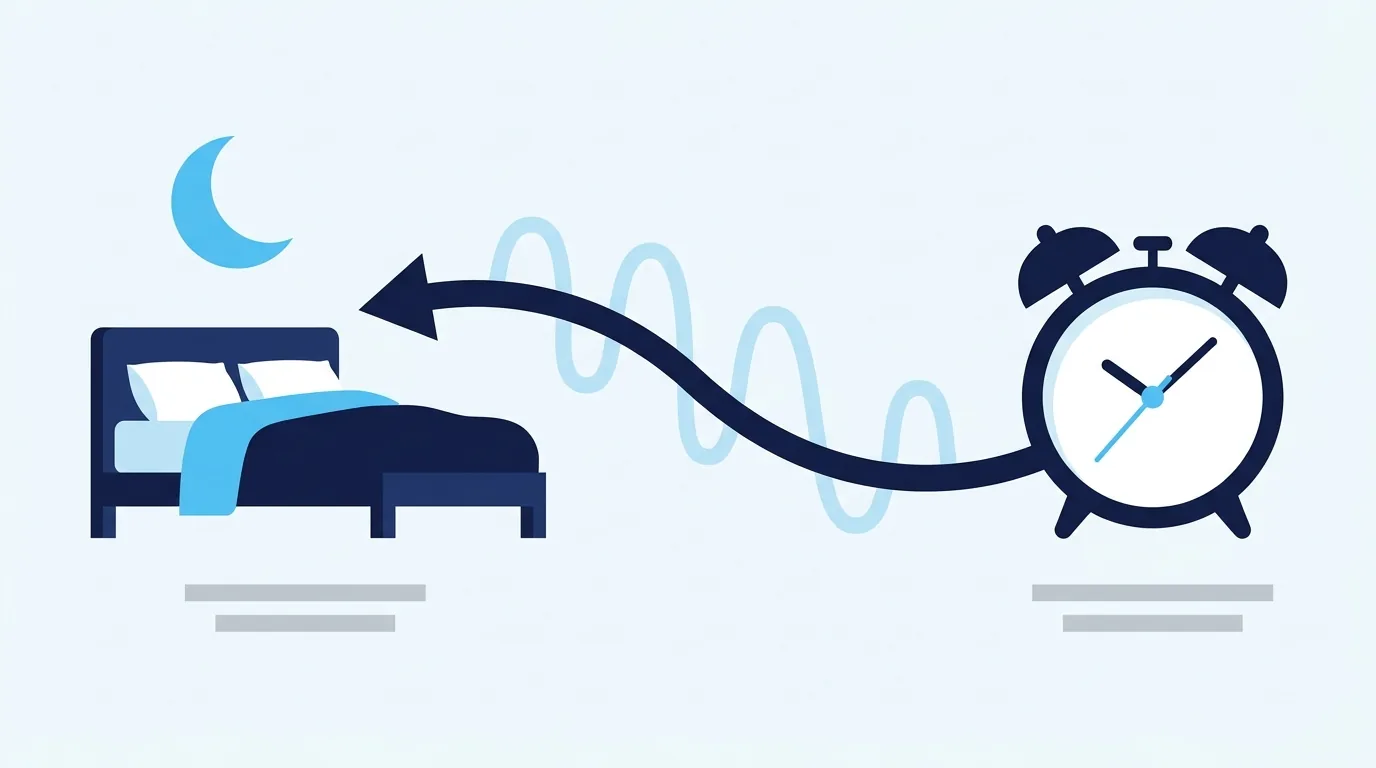
Your bedtime is your wake-up time, minus the sleep you need, minus the time it takes you to fall asleep. For most adults that means counting back at least seven hours from the alarm (the amount the CDC and the American Academy of Sleep Medicine recommend for ages 18 to 60) plus about 15 minutes to drift off. A 6 AM alarm puts you in bed by 10:45 PM at the latest and closer to 9:45 PM if you need eight hours. A 7 AM alarm moves each of those an hour later. There is no single right clock time for everyone, but there is a single right place to start: the alarm you can't move.
The rest of this page is the working. It covers how much sleep you actually need at your age, how to count back from any wake time, how to correct for the minutes you spend lying awake, and what to do if your body clock runs late. It ends with a decision tree that routes you to the right bedtime for your own alarm.
Why should a bedtime start from the alarm, not the evening?
Because the alarm is usually the one fixed point in your day. School starts when it starts. The shift begins at 7. The train leaves at 7:40. Your evening is flexible by comparison, even when it doesn't feel that way, so it is the evening that has to give.
Most people do this backwards. They go to bed "when they're tired" or "after the show" and then let the alarm decide how much sleep they got. That works only if the evening reliably ends early enough, and for most weeks it doesn't.
Starting from the alarm flips the question from "when do I feel like sleeping?" to "when do I have to be asleep for tomorrow to go well?" That second question has an answer you can write down.
The one case where this logic bends is when you have no fixed wake time at all: freelancers, retirees, anyone on a flexible schedule. Even then, the NHLBI healthy sleep habits guidance recommends going to bed and waking at the same time every day. So pick a wake time you will keep, and treat it as fixed.
How much sleep does an adult actually need?
The consensus figure is seven or more hours on a regular basis. That comes from the joint consensus statement of the American Academy of Sleep Medicine and the Sleep Research Society, which recommends "7 or more hours of sleep per night on a regular basis" for adults aged 18 to 60, and notes that individual need varies with genetics, behavior, health and environment.
The CDC's age-group recommendations extend that across the lifespan:
| Age | Recommended sleep per day (CDC) |
|---|---|
| 6 to 12 years | 9 to 12 hours |
| 13 to 17 years | 8 to 10 hours |
| 18 to 60 years | 7 or more hours |
| 61 to 64 years | 7 to 9 hours |
| 65 and older | 7 to 8 hours |
Two things are worth reading into that table.
First, seven is a floor for adults, not a target. If you routinely feel rested on seven and a half, that is your number. If you need eight and a half to function, that is your number too. The only way to find it is to hold a consistent schedule for a couple of weeks and notice how you feel by mid-afternoon.
Second, teenagers need noticeably more than adults. A 13 to 17 year old with a 6:30 AM school alarm needs to be asleep somewhere between 8:30 and 10:30 PM to land inside the recommended range. That is earlier than most households assume.
How do you count back from any wake time?
Take the alarm time. Subtract the hours of sleep you want. Subtract your time to fall asleep. The result is when you need to be in bed with the lights off.
Here is that arithmetic done for the common wake times, with a 15 minute allowance to fall asleep already included:
| Alarm | 7 hours | 7.5 hours | 8 hours | 9 hours |
|---|---|---|---|---|
| 5:00 AM | 9:45 PM | 9:15 PM | 8:45 PM | 7:45 PM |
| 5:30 AM | 10:15 PM | 9:45 PM | 9:15 PM | 8:15 PM |
| 6:00 AM | 10:45 PM | 10:15 PM | 9:45 PM | 8:45 PM |
| 6:30 AM | 11:15 PM | 10:45 PM | 10:15 PM | 9:15 PM |
| 7:00 AM | 11:45 PM | 11:15 PM | 10:45 PM | 9:45 PM |
| 7:30 AM | 12:15 AM | 11:45 PM | 11:15 PM | 10:15 PM |
| 8:00 AM | 12:45 AM | 12:15 AM | 11:45 PM | 10:45 PM |
| 9:00 AM | 1:45 AM | 1:15 AM | 12:45 AM | 11:45 PM |
The 7.5 hour column is there because it is what most sleep calculators hand you: five sleep cycles of roughly 90 minutes. Sleep does run in cycles. The NHLBI description of sleep stages says the cycle "starts over every 80 to 100 minutes" and that there are usually four to six cycles a night. But 80 to 100 minutes is a range, not a constant, so a bedtime aligned to the minute is more precise than the biology behind it. Use cycle alignment as a tiebreaker between two bedtimes you could equally hit, not as a reason to sleep less. We went through the full cycle-length problem, with worked numbers, in what time to go to bed to wake up at 6 AM.
How much time should you add for falling asleep?
Fifteen minutes is the convention, and it is the number our table uses. It is also the input people get wrong most often, because it is a guess about you, not a measured fact.
There is no fixed figure for how long a healthy person takes to fall asleep. It moves with caffeine, stress, a late meal, a bright screen, and how much sleep you owe. So the useful move is to replace our 15 with your own honest estimate. Here is what that does to a 6:30 AM alarm with an eight hour target:
| Your usual time to fall asleep | In bed by |
|---|---|
| About 5 minutes | 10:25 PM |
| About 15 minutes | 10:15 PM |
| About 30 minutes | 10:00 PM |
| About 45 minutes | 9:45 PM |
That 40 minute spread is bigger than the whole argument about whether cycles are 90 or 100 minutes long. If you only correct one number in any bedtime plan, correct this one.
A caveat: if lying awake for a long time is your normal, and it is costing you your days, a later or earlier bedtime is not the fix. Trouble falling asleep that persists for weeks is worth raising with a doctor, because it has real treatments and bedtime arithmetic is not one of them. This page is general information, not medical advice.
Does being a night owl change the answer?
It changes how hard the answer feels, not what it is.
People differ in when their body clock wants them asleep. Some are drowsy by 9:30 PM. Others feel wide awake at 11:30 PM and dreadful at 6:30 AM. That preference, usually called chronotype, is real, and it is why two people with the same alarm can find the same bedtime easy and impossible.
What doesn't change is the subtraction. If your alarm is 6:30 AM and you need eight hours, you still need to be asleep around 10:30 PM. A night owl simply has to work harder to get there.
The lever that works is light. The NIGMS fact sheet on circadian rhythms notes that light and dark have the biggest influence on the body's daily rhythms, and that the brain's master clock controls melatonin production based on how much light the eyes receive. In practice that means:
- Get bright light early. Outdoor light soon after waking is the strongest signal you can give your clock to run earlier.
- Dim the evening. NHLBI suggests using the hour before bed for quiet time and avoiding bright artificial light from TVs and computer screens.
- Hold the wake time, including weekends. Pulling the morning in is what drags the evening earlier. Sleeping late on Saturday undoes it.
- Move in small steps. Shift bedtime 15 to 20 minutes at a time and hold each step for several nights before taking the next.
If your natural rhythm and your required wake time are several hours apart, and months of consistent effort don't close the gap, that is a clinician's conversation too.
Which wake time are you planning around?
Here is the whole page as a decision tree. Follow it once and you have tonight's bedtime.
1. Is your wake time fixed?
- Yes. Write it down. That is your anchor. Go to step 2.
- No, it varies day to day. Pick the earliest wake time you need on a regular basis and treat that as fixed for the whole week. Go to step 2.
- You work nights or rotating shifts. The rules above assume a daytime schedule. Go to the night shift sleep schedule instead, which builds the day around a fixed anchor block of sleep.
2. How much sleep do you need?
- Aged 13 to 17: plan for 8 to 10 hours.
- Aged 18 to 60: plan for at least 7. Start at 7.5 or 8 if you don't know your number yet.
- 61 to 64: 7 to 9. 65 and older: 7 to 8.
3. How long do you usually take to fall asleep?
- Quickly (under 10 minutes): subtract 5 to 10 minutes.
- Average: subtract 15.
- Slowly (half an hour or more): subtract 30 to 45, and read the caveat above.
4. Your bedtime window is the wake time minus steps 2 and 3. Set it as a range of about 20 minutes, not a single minute.
5. Now go to your alarm:
- 4:30 AM: set an alarm for 4:30 AM
- 5:00 AM: set an alarm for 5 AM
- 5:30 AM: set an alarm for 5:30 AM
- 6:00 AM: read what time to go to bed to wake up at 6 AM, then set an alarm for 6 AM
- 6:30 AM: set an alarm for 6:30 AM
- 7:00 AM: set an alarm for 7 AM
- 7:30 AM: set an alarm for 7:30 AM
- 8:00 AM or later: set an alarm for 8 AM, or any time you like on the online alarm clock
If you get the bedtime right and still wake up foggy, the problem is probably the first 20 minutes after the alarm, not the night before. That is sleep inertia, and why you wake up groggy covers what shortens it.
The fastest way to do all of this: enter your alarm time on the sleep calculator and read off tonight's bedtimes. It counts back in 90 minute cycles with 15 minutes to fall asleep already built in, so adjust by your own number from step 3. It's free, runs in the browser, and needs no account.
FAQ
Is 10 PM a good bedtime for adults?
For a lot of adults, yes. With a 6 AM alarm it gives you close to eight hours once you allow 15 minutes to fall asleep, and with a 7 AM alarm close to nine. There is also some supporting research on the clock time itself. A UK Biobank cohort study published in the European Heart Journal: Digital Health measured sleep onset with wrist accelerometers in 103,712 participants over seven days and followed them for an average of 5.7 years. Falling asleep between 10:00 and 10:59 PM was associated with the lowest rate of cardiovascular disease. That is an association in an observational study, not proof that 10 PM causes better health, and the authors frame it as a possible relationship. The more reliable rule is still enough hours at a consistent time.
Is it bad to go to bed after midnight?
Not automatically. If your alarm is 8 or 9 AM, a bedtime after midnight can still give you eight hours, and the table above shows exactly that. The problem is going to bed after midnight with a 6 or 7 AM alarm, because the arithmetic no longer leaves room for seven hours. In the same UK Biobank study, sleep onset at or after midnight was associated with higher cardiovascular risk than 10 PM onset, but again that is an observational link rather than a verdict on every late sleeper.
Should my bedtime be the same on weekends?
As close as you can manage. NHLBI recommends keeping the same sleep schedule on weeknights and weekends and limiting the difference to no more than about an hour, because staying up and sleeping in late can disrupt your body clock. The wake time matters most. Holding it on Saturday and Sunday is what makes Monday's bedtime feel normal instead of early.
Does going to bed earlier help if I wake up tired?
Sometimes. If you are currently getting less than seven hours, an earlier bedtime is the obvious first fix, and it should be done in 15 to 20 minute steps rather than all at once. If you are already getting seven to nine hours on a steady schedule and still wake up tired week after week, more time in bed is unlikely to be the answer. Persistent unrefreshing sleep is a good reason to see a doctor, because it can point to issues a bedtime can't touch.
Sources
- CDC, About Sleep: recommended hours of sleep by age group
- Watson et al., Recommended Amount of Sleep for a Healthy Adult, joint consensus statement of the AASM and Sleep Research Society, Sleep, 2015: seven or more hours for adults 18 to 60
- NHLBI (NIH), Sleep Phases and Stages: cycles of 80 to 100 minutes, four to six per night
- NHLBI (NIH), Healthy Sleep Habits: consistent schedule, weekend difference of about an hour, quiet hour before bed
- NIGMS (NIH), Circadian Rhythms: light as the strongest influence on the body clock
- Nikbakhtian et al., Accelerometer-derived sleep onset timing and cardiovascular disease incidence, European Heart Journal: Digital Health, 2021