
Social Jet Lag: Measure Your Weekend Sleep Shift
By Mark Fulton · 2026-10-28 · Last verified Oct 28, 2026 · 11 min read
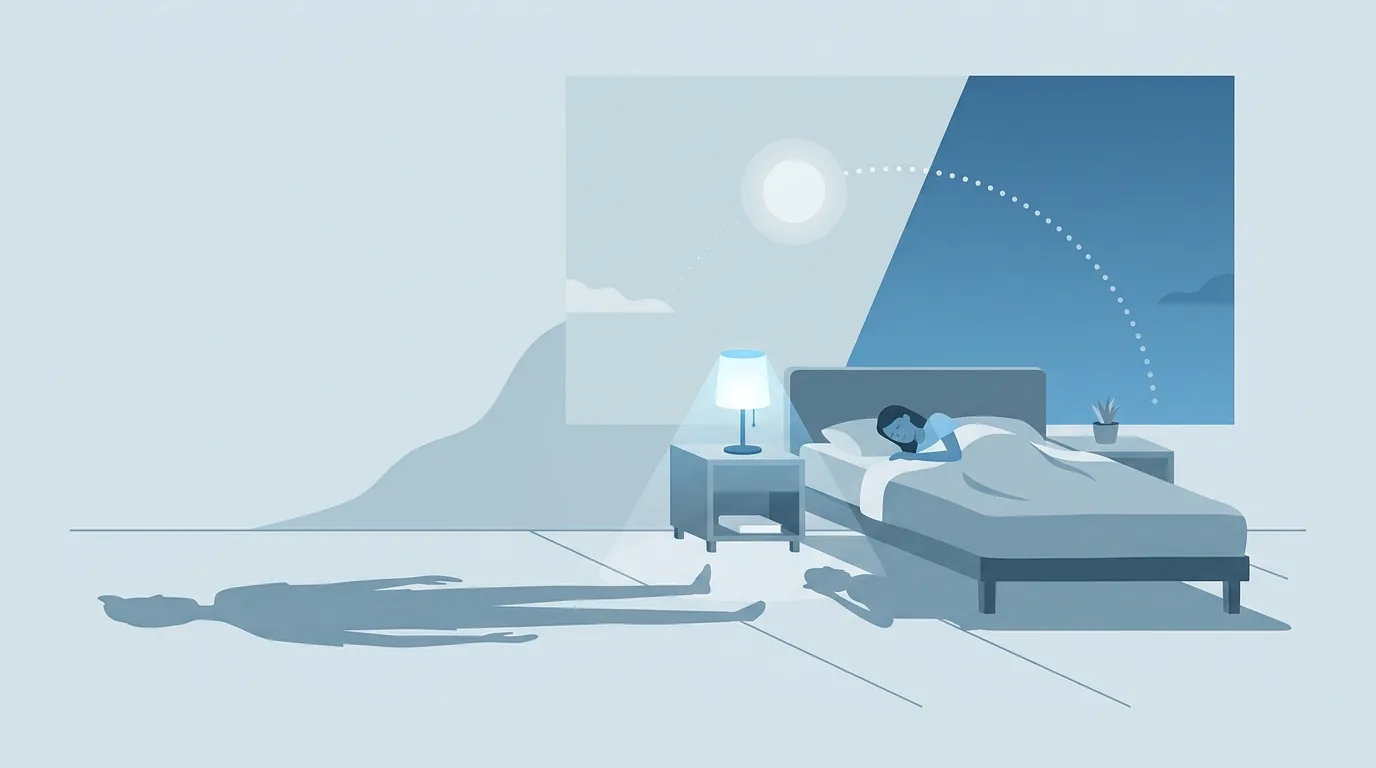
Social jet lag is the difference between the middle of your sleep on work nights and the middle of your sleep on free nights. Work out the midpoint of each (halfway between falling asleep and waking up), subtract the earlier from the later, and the answer in hours is your social jet lag. If you sleep from 23:30 to 06:30 on weekdays and from 01:30 to 10:30 on weekends, your midpoints are 03:00 and 06:00, so your weekend sleep sits three hours later than your weekday sleep. The worked week below shows the arithmetic step by step, then repeats it with a weekend alarm one hour later instead of three. Every time in this article is made up to show the method. This is general information, not medical advice.
What is social jet lag?
The term comes from sleep researchers in Munich. In a 2006 paper titled Social jetlag: misalignment of biological and social time, Marc Wittmann, Till Roenneberg and colleagues described the discrepancy between social and biological timing, the gap between work days and free days, as "social jetlag." They found that late chronotypes, people whose body clocks prefer late nights and late mornings, showed the largest differences in sleep timing between work and free days. They also reported sleep debt building on work days and being compensated for on free days.
The name borrows from travel jet lag, and the comparison is useful but loose. A later review by Roenneberg and colleagues, Chronotype and Social Jetlag: A (Self-) Critical Review, draws the line itself: travel jet lag is a transient mismatch while the body clock catches up to a new light-dark cycle, whereas social jet lag is chronic, because the mismatch between the body clock and the social schedule repeats every week.
Put plainly, nobody boarded a plane. Your alarm clock moved your wake-up time on Monday, and your weekend moved it back. The measure is simply how far.
How do you calculate your own social jet lag?
You need two numbers: when you fall asleep and when you wake up, on work days and on free days. The review defines the measure as the difference between the average midpoint of sleep on workdays and the average midpoint on work-free days. Four steps:
- Write down a typical work night. The time you fall asleep (not the time you get into bed) and the time you wake up.
- Find its midpoint. Take the total sleep time, halve it, and add that to the time you fell asleep.
- Do the same for a typical free night.
- Subtract. Free-night midpoint minus work-night midpoint. That is your social jet lag in hours and minutes.
If you only know your bedtime, subtract a guess for how long you take to fall asleep. Our sleep calculator lets you set that allowance, and what time should I go to bed explains how to estimate it. A free night here means a night with no alarm and no early obligation the next morning.
The arithmetic is plain subtraction, but midpoints across midnight trip people up. Work in a 24-hour clock and count hours from the time you fell asleep. A sleep from 23:30 to 06:30 is seven hours, half of that is 3 hours 30 minutes, and 23:30 plus 3:30 is 03:00. Do not average the two clock times directly. Midnight breaks that shortcut.
What does a worked week look like?
Here is an illustrative week. These times are invented to demonstrate the method; they are not a typical person, a study result or anyone's real data. Five work nights, two free nights, and a weekend that drifts late.
| Falls asleep | Wakes up | Sleep | Midpoint | |
|---|---|---|---|---|
| Work nights (Sun to Thu) | 23:30 | 06:30 | 7h 00m | 03:00 |
| Free nights (Fri, Sat) | 01:30 | 10:30 | 9h 00m | 06:00 |
Social jet lag: 06:00 minus 03:00 = 3 hours.
Say that out loud and it sounds like a flight. Every Friday night this person lets the body clock slide three hours later, and every Sunday night the alarm drags it back. The weekend feels like a holiday in a later time zone, and Monday is the return flight without the airline.
The Munich review also publishes a refinement called sleep-corrected social jet lag. It adjusts the free-day midpoint for oversleep, so that sleep debt being repaid does not exaggerate the shift. The correction works like this:
- Average sleep across the week, weighted by nights: (5 x 7h + 2 x 9h) / 7 = about 7h 34m.
- Oversleep on free days: 9h minus 7h 34m = about 1h 26m.
- Corrected free-night midpoint: 06:00 minus half the oversleep (about 43 minutes) = about 05:17.
- Corrected gap: 05:17 minus 03:00 = about 2 hours 17 minutes.
You do not need the corrected figure to act on this. It is useful as a reminder that part of that weekend lie-in is sleep catching up, and part is the clock moving. Both are real, and both go away if the weekend wake time stays close to the weekday one.
How much weekend shift is too much?
There is no published cutoff I can hand you, and I would be inventing one if I did. What the research does support is a direction: the larger the gap between social time and body time, the more studies have linked it to worse outcomes.
The Munich review notes associations between social jet lag and metabolic disorders and obesity, and between social jet lag and depressive symptoms, and it is careful about what that evidence is. Most of the studies are cross-sectional, meaning they measure people at one point in time, so they cannot show that the gap caused anything. The authors state that further longitudinal studies are needed to clarify how much and for how long someone must be exposed to social jet lag before consequences follow.
A commentary in Nature Reviews Endocrinology by Roenneberg, How can social jetlag affect health?, frames it the same way: the more misaligned the clocks are, the higher the odds of developing certain diseases. That is a statement about odds across populations, not a diagnosis of you.
So treat any size of gap as a dial, not a threshold. As a working rule on this page, and nothing more than a rule of thumb, aim to keep the weekend wake time within about an hour of the weekday one. That is a target for the experiment below, not a medical line. If you are sleepy all day whatever your schedule, wake unrefreshed after long nights, or worry about your sleep, a doctor is the right call, not a smaller number.
Why does Monday morning feel like jet lag?
Two things stack up on Monday. The alarm is early, and your body has spent two days settling into a later schedule.
That second part is the part people underestimate. The review points to controlled and real-life studies in which circadian markers, such as melatonin and cortisol timing, moved along with shifted sleep times quite quickly, for example about 45 minutes after only two days. So a weekend of late nights and late mornings is not just a lie-in. Your internal timing is travelling a short way with you, and Monday asks it to come back in one night.
It also explains why Sunday night is hard. If your body has drifted three hours late, 23:00 on Sunday feels like 20:00. You are not being dramatic when you cannot fall asleep. The clock you are trying to sleep to is not the clock your body kept all weekend. If you have read our jet lag schedule shift plan, the logic is the same one in reverse: moving earlier is harder than moving later, which is why recovering from a late weekend takes longer than creating one.
Waking groggy at an early hour is a separate effect with its own mechanism. Why you wake up groggy covers sleep inertia and what helps in the first half hour.
Does sleeping in on weekends pay back sleep debt?
Partly, and it comes with a cost. In the Munich data, people who build up sleep debt during the work week mostly compensate by sleeping in on free days, not by going to bed earlier. That is exactly the pattern in the table above: the free-night sleep is two hours longer, and almost all of the extra comes from waking later.
The lie-in does give you more hours of sleep. What it also does is move the midpoint, and the midpoint is the part your body clock reads. You can buy back some hours on Saturday morning and pay for it with a later clock on Sunday night. Whether the trade is worth it depends on how short your weekday sleep is.
That points at the real fix. If the weekday night is short, the lie-in is sleep debt being repaid, and the better lever is the weekday bedtime, not the weekend alarm. The sleep-corrected figure above is the same idea expressed as a number. For the weekday side, see what time to go to bed to wake up at 7 AM for the arithmetic.
If your weekday sleep is already seven hours or more and you still sleep for nine on weekends, the lie-in is more about timing than debt.
How do you shrink the gap without losing your weekend?
Anchor the wake time. Keep a weekend alarm no more than an hour past the weekday alarm, and let the extra sleep come from an earlier bedtime on Friday and Saturday, not from a later morning.
Here is the same week redone that way. The weekday nights are unchanged. On free nights, the person falls asleep at midnight and wakes at 07:30 with an alarm.
| Falls asleep | Wakes up | Sleep | Midpoint | |
|---|---|---|---|---|
| Work nights (Sun to Thu) | 23:30 | 06:30 | 7h 00m | 03:00 |
| Free nights, anchored | 00:00 | 07:30 | 7h 30m | 03:45 |
Social jet lag: 03:45 minus 03:00 = 45 minutes. The corrected version, using the same method as before, comes out at about 34 minutes.
The weekend still has a later morning, 07:30 instead of 06:30, and half an hour more sleep each night than a weekday. The Friday and Saturday nights end an hour and a half earlier than the original plan, which is the cost, and for most people the easier trade, because it removes the Sunday-night wall.
One more version shows why the bedtime matters as much as the alarm. Keep the late 01:30 bedtime but add the anchored 07:30 alarm:
| Weekend pattern | Falls asleep | Wakes up | Sleep | Midpoint | Gap |
|---|---|---|---|---|---|
| Original lie-in | 01:30 | 10:30 | 9h 00m | 06:00 | 3h 00m |
| Alarm anchored, bedtime unchanged | 01:30 | 07:30 | 6h 00m | 04:30 | 1h 30m |
| Alarm anchored, earlier bedtime | 00:00 | 07:30 | 7h 30m | 03:45 | 0h 45m |
The middle row is the trap. The gap halves, but the person now sleeps six hours on a free night, shorter than any weeknight. An anchored alarm with an unchanged bedtime trades social jet lag for sleep debt. The earlier bedtime in the last row is what makes the number small and the sleep adequate at once.
What if your weekend plans run late?
Keep the alarm anchored and take the lost sleep in daylight, not at the start of the day. If you were out until 02:00, a short nap in the early afternoon recovers some of the shortfall without moving the next night's bedtime much. The 20-minute nap covers how long to make it and when to stop.
What is the one change worth making first?
Set a Saturday alarm. Not a punishing one: a time no more than an hour past your weekday wake-up. Then watch what happens to Sunday night.
For two weeks, write down fall-asleep and wake-up times each morning on a note. After two weeks, calculate your gap using the four steps above. Then compare it with the earlier week. The point is to measure your own, not to take any number on this page as the standard.
Then check the weekday side. If you only get seven hours on a work night, the smaller gap will feel better only if the extra weekend sleep has somewhere to come from. Is 6 hours of sleep enough? goes through what the guidance says about the weekday floor.
FAQ
Is sleeping in on weekends bad?
Not in itself. A later morning gives you more hours of sleep, and if your weekday nights are short, you may need them. The cost is the shift: a much later wake time moves your sleep midpoint, and that is the thing the research ties to social jet lag. A modest lie-in with an earlier bedtime keeps most of the benefit and little of the shift. The evidence linking social jet lag to health outcomes is mostly cross-sectional, so it shows association, not proven harm.
How many hours of social jet lag is normal?
There is no standard figure to quote. The measure is a continuous number, and the Munich researchers note that late chronotypes show the largest work-day to free-day differences. Larger gaps have been associated with worse outcomes in studies, but I do not know of an agreed line below which it is "fine." The practical answer is to calculate your own and try to bring it down.
Can you catch up on sleep on weekends?
You can recover some sleep hours, and many people do exactly that. The Munich data describes people compensating for weekday sleep debt by sleeping in on free days. What a weekend lie-in cannot do is erase a pattern of short weeknights without moving your body clock later. If you are short of sleep every weekday, the better fix is an earlier weekday bedtime. Our sleep calculator counts back from your alarm.
Should I set an alarm on Saturday?
If you want a smaller gap, yes, set one, no more than about an hour past your weekday alarm. It does not have to be early. It has to be consistent enough that Sunday night does not feel like a different time zone. Pair it with an earlier Friday and Saturday bedtime so the alarm does not cut your sleep short. You can set one on the online alarm clock.
Set a Saturday alarm no more than an hour past your weekday one on the online alarm clock, then calculate your gap again in two weeks. This article is informational and is not medical advice.