
Sleep for 1 Hour or Stay Awake? How to Decide
By Mark Fulton · 2026-10-01 · 9 min read
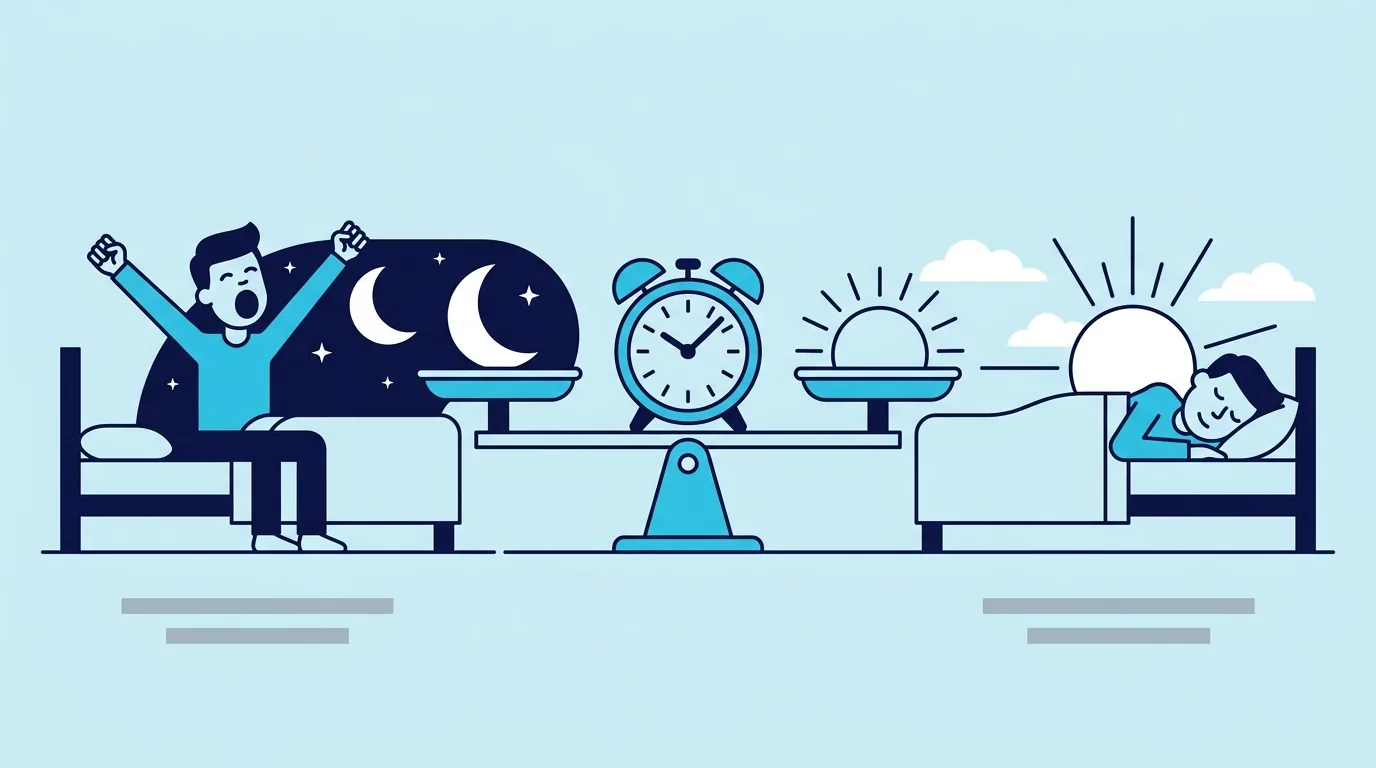
In most cases, some sleep beats none. But a one-hour sleep is the awkward length: it is more likely to end in deep sleep, so you can wake feeling worse than you expected. If you can fit it, aim for about 90 minutes, or take a 20-minute nap instead. And if you have to drive tomorrow, no timing trick makes a sleepless night safe.
That is the short version. The rest of this post is the part people actually need at 3 AM: a way to decide based on three things you already know, how long until you must be up, whether you have to drive or operate anything, and whether you can nap later. This is general information, not medical advice.
What happens if you sleep for only an hour?
You get a partial dose of sleep, and it does something real. Sleep builds up as pressure the longer you are awake, and even a short sleep lets some of it off. That is why an hour usually feels better than nothing at the eight-hour mark of a long night.
What an hour does not do is finish a night. Sleep runs in cycles that average roughly 90 minutes, moving through lighter stages, deep sleep and REM. That figure is an average, and it varies from person to person and night to night. In the first stretch of a night, deep sleep tends to arrive early. An hour of sleep can therefore leave you with a good share of deep sleep and none of the lighter stretch after it.
Staying awake, meanwhile, is not neutral. The Sleep Foundation's overview of going without sleep describes alertness, mood and judgment all declining after a full day awake, and notes that being awake for 24 hours has cognitive effects comparable to a blood alcohol concentration of 0.10%. That is why the honest default is to take whatever sleep is available.
Why can a short sleep feel worse than none?
Because of sleep inertia, the heavy, slow, can't-think state in the first minutes after waking. It is worst when you are pulled out of deep sleep, and a short sleep that ends mid-deep-sleep is exactly that situation. We cover the mechanism in why you wake up groggy, so we won't repeat it here. The practical upshot for this decision:
- A 60-minute sleep can end in the worst possible place. Waking from deep sleep means more grogginess, and the grogginess can last a while.
- The grogginess is temporary, and it is not the same as being rested or not. Feeling worse for 20 or 30 minutes after waking does not mean the sleep did nothing. It means you should not schedule anything important in the first half hour.
- A very short nap avoids the problem. Around 20 minutes usually stays in lighter sleep, which is the whole logic behind the 20-minute nap.
So if the question is "will an hour of sleep leave me feeling worse than staying up," the answer is sometimes yes for the first half hour, and rarely yes by midday.
How long should the sleep be if you take it?
You have three practical choices, and the right one depends on the time you have.
| Time until you must be up | Best option | Why |
|---|---|---|
| Under 1.5 hours | A 20-minute nap, or rest with your eyes closed | Not enough time for a full cycle, and a nap avoids deep sleep and the grogginess that follows |
| 1.5 to 3 hours | One full cycle of about 90 minutes, alarm set for the full 90 | Gives the sleep a chance to finish a cycle and land in a lighter stage |
| Over 3 hours | Sleep now, alarm set for a cycle-length multiple, roughly 3 hours or 4.5 hours | More than one cycle, and you still have time for a wind-down and a margin |
Two things make this table work in practice.
Set the alarm for the length you want, not the time you want to wake. Count from when you expect to fall asleep, not from when you get into bed. Falling asleep when you are anxious about the deadline can take a while, and that is the part people forget. Add 10 to 15 minutes as a rough allowance and adjust for yourself. If you have sleep-calculator habits already, our sleep calculator does this arithmetic for you.
Treat the 90 minutes as a target, not a promise. The cycle length is an average, so a 90-minute alarm can still land you in a deeper stage. It improves the odds. It does not guarantee a clean wake.
What changes if you have to drive tomorrow?
Everything, and not in a way that a clever alarm can fix.
Drowsy driving is one of the places where the advice stops being "optimize" and becomes "don't." The CDC's NIOSH training material on long work hours puts numbers on it: being awake for 17 hours is similar to a blood alcohol concentration of 0.05%, and being awake for 24 hours is similar to 0.10%, compared with the 0.08% legal limit for driving in the US. A short sleep helps with sleepiness, but it does not put you back at a fully rested baseline.
So the rule for this decision tree is simple:
- Sleep, even a short sleep, always beats driving after no sleep. If you will be behind the wheel, take the sleep.
- A short sleep does not clear you to drive long distances. If you are still heavy-eyed and your reaction time feels slow, that is information, not something to push through.
- Get another way to travel when you can. A ride, a train, a driver, a delayed start. A flight departure after a sleepless night is a different situation from a two-hour drive at dawn, but both are worth planning around.
- The same goes for anything where a slip hurts someone, such as heavy machinery, medication handling or childcare. Those are reasons to move the schedule, not reasons to be clever with a nap.
Nothing here is a threshold that makes driving safe. It is the opposite: it is a reason not to treat this as a timing puzzle.
The decision tree
Here is the whole thing in one place. Start at the top and stop at the first row that fits.
| Hours until you must be up | Must you drive or operate anything? | Can you nap afterwards? | Do this |
|---|---|---|---|
| Under 1.5 | Yes | Either | Take a 20-minute nap now, then arrange another way to travel or move the start. Do not drive on a sleepless night |
| Under 1.5 | No | Yes | Stay up, or rest 20 minutes. Plan a nap later in the day |
| Under 1.5 | No | No | A 20-minute nap now. Skip the one-hour sleep, which risks waking in deep sleep |
| 1.5 to 3 | Yes | Either | Sleep now, alarm for the full 90 minutes. Reassess before driving, and have a backup |
| 1.5 to 3 | No | Either | Sleep now, alarm for the full 90 minutes |
| Over 3 | Yes | Either | Sleep now, alarm for roughly 3 or 4.5 hours. Do not trade sleep for last-minute prep |
| Over 3 | No | Either | Sleep now, alarm for a cycle multiple. You have room to do this properly |
The pattern in the table: the only row where "stay up" wins is when there is genuinely no time and no driving. Every other row ends in some sleep.
How do you get through the day after an all-nighter?
Sometimes you will not sleep, whether because of a deadline, a flight, a sick child or a bad night. Then the goal is damage control.
- Get bright light early, and keep it up through the morning. Light is the strongest cue for being awake.
- Move. A short walk helps alertness more than another coffee.
- Use caffeine early and in small amounts, and stop well before the afternoon, so that it does not push tonight's sleep later.
- Put the demanding work in your best hour, and the easy work in the slump. Expect a dip in the afternoon.
- Do not make irreversible decisions. Judgment is one of the first things to go.
- Plan a short nap if you can. Set a timer, because the timer is what keeps a 20-minute nap from turning into an hour. A 20-minute timer on your phone or laptop does the job.
- Eat light and regularly. A heavy lunch makes the dip worse.
How do you recover the following night?
Recovery is less dramatic than people expect, and the advice is boring on purpose.
- Go to bed at a normal time, or a little early. Do not sleep in far past your usual wake time, which can push your whole schedule later.
- Keep the wake time steady. A consistent alarm matters more than a perfect bedtime. Set one on the online alarm clock and keep it the same.
- Skip caffeine in the afternoon, and avoid alcohol as a sleep aid.
- Do not expect one night to repay the debt. Recovery is usually spread over a few ordinary nights, and it varies by person.
For the target, the CDC's sleep page lists 7 or more hours a night for adults aged 18 to 60. That is a useful reference point when you plan the recovery night.
When is this not a timing problem?
If short or missed sleep is your normal, not your emergency, the real problem is upstream of any of this. Difficulty falling asleep, waking repeatedly, or being sleepy during the day despite enough time in bed are worth a conversation with a doctor or sleep specialist. A decision tree is for the one-off night.
Frequently asked questions
Is 90 minutes of sleep better than none?
Usually yes. Ninety minutes is about one average sleep cycle, which gives the sleep a better chance of ending in a lighter stage, so it tends to feel better than an hour. It is still a short night, and cycle length varies from person to person. It does not make driving after a night with little sleep safe.
Should I stay up all night before an exam?
Generally, sleep is the better choice. Judgment, attention and memory all suffer when you are short on sleep, and the exam draws on all three. If you must choose, take a cycle-length sleep and set the alarm for it, then use the time after you wake to review. If there is truly no time, a 20-minute nap beats nothing.
Is a 20-minute nap better than an hour of sleep?
Often, when your window is short. A 20-minute nap tends to stay in lighter sleep, so you wake with less grogginess. An hour risks ending in deep sleep. If you have 90 minutes or more, a full cycle is usually a better use of the time than either.
How long does it take to recover from an all-nighter?
It varies by person, and there is no single number to give. Most people feel noticeably better after a normal night of sleep, with the rest of the debt paid back across a few ordinary nights. If you feel off for much longer than that, or this happens often, it is worth raising with a clinician.
The alarm that goes with this
If you are going to sleep, the one setting that matters is the length. Set the alarm for a full 90 minutes on the online alarm clock, not 60. If you only have time for a short rest, a 20-minute timer keeps it from running long.
This post is general information about sleep and is not medical advice. If you have ongoing trouble sleeping, or concerns about drowsiness and safety, talk to a doctor or other qualified professional.