
Falling Back an Hour: How to Adjust Your Sleep
By Mark Fulton · 2026-09-30 · 10 min read
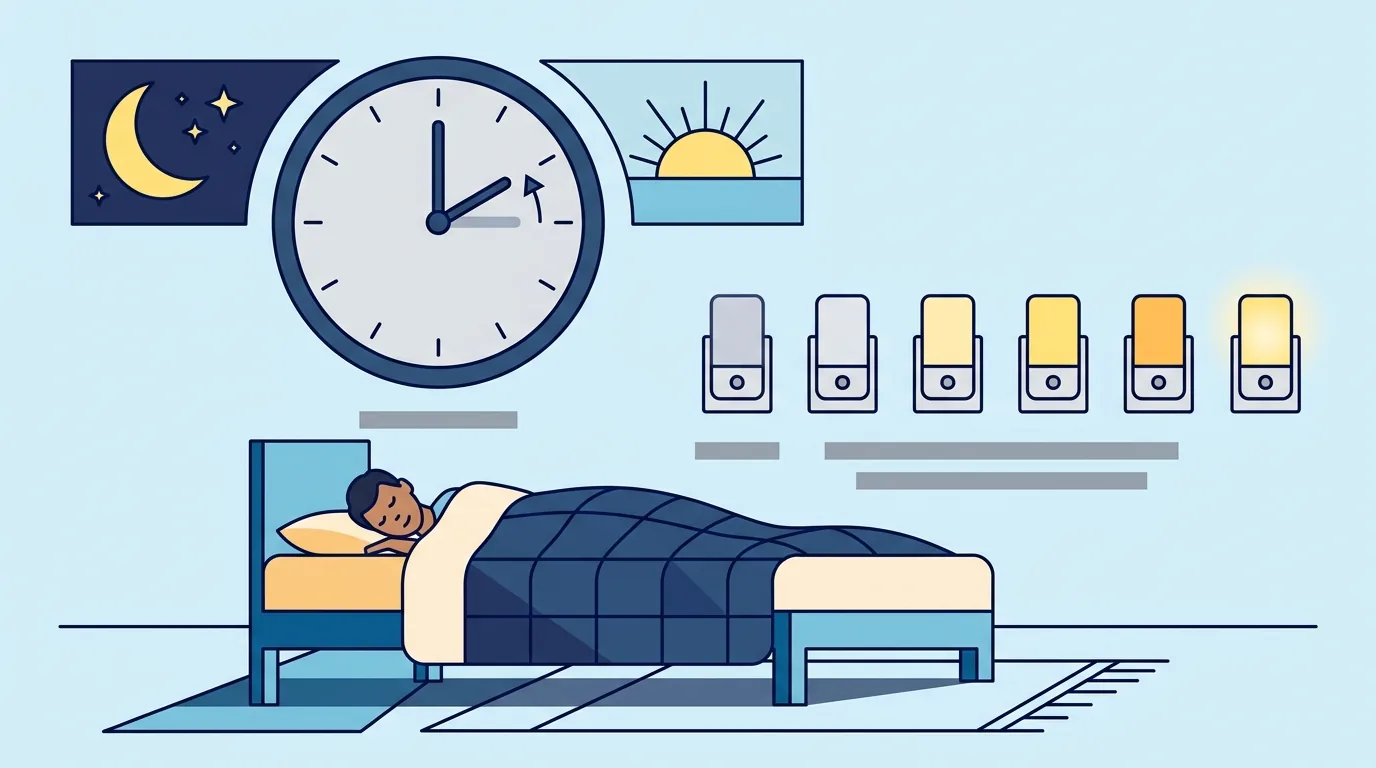
To adjust your sleep for the fall time change, move your bedtime and your alarm 15 minutes later each night for the four nights before the clocks go back, keep the alarm as your anchor, and get bright light soon after you wake. In the US the change happens at 2 a.m. on Sunday, November 1, 2026. Done this way, the hour you gain lands on a body that has already drifted to meet it, so you wake at your usual clock time on Monday instead of an hour early.
That is the whole plan. The rest of this post explains why fall back still catches people out, gives you a night-by-night timeline with exact times, and covers what to do if you cannot shift in advance.
Why does falling back still disrupt sleep?
Falling back looks like a gift. The clock says 2:00 a.m. twice and you get an extra hour in bed. That part is true on the night itself.
The trouble starts the next morning. Your body clock does not read your phone. It runs on a roughly 24-hour cycle that is set mostly by light and dark, and it keeps waking you at the time it learned. If you normally wake naturally at 6:00, your body will try to do that on Sunday, but the clock on the wall now says 5:00. You are awake an hour early with nothing to show for the extra hour.
The Cleveland Clinic's guide to circadian rhythm puts the mechanism plainly: light and dark have the biggest effect on the body clock, and light reaching the eye tells the brain to stop producing melatonin. So a clock change moves the sun relative to your schedule. Your evening gets dark an hour earlier by the wall clock, and your body, still on the old timing, is not tired yet.
The Sleep Foundation's overview of daylight saving time notes that major sleep disruptions are less likely in November than in March, and that for many people the change is an opportunity for an extra hour of sleep. It also says some people have difficulty adjusting to the new wake-up time, and that the effects gradually fade. Both things are true, and the second group is who this post is for.
Who feels the fall change most?
Most people shrug this one off. Sleep Health Foundation Australia, in its guide to daylight saving and sleep, says the change back usually takes only about one night to settle. If that is you, you can stop reading and enjoy the hour.
A few groups get caught:
- Early risers. If you wake before your alarm anyway, the change effectively cuts your morning short. You wake at what feels like 6:00 and the clock says 5:00.
- People with a fixed early alarm. Shift workers, commuters and anyone with a 5:30 start have no slack. The body wants to sleep in relative to the clock, and the alarm does not care.
- Parents. Children do not read clocks, and the same guide notes children may take longer to adjust. Your alarm is their internal wake-up time, and it just moved an hour against you. There is a section on this further down.
- Anyone already short on sleep. If your baseline is thin, a week of early wake-ups shows up faster.
- Night owls with an early Monday. The extra Sunday hour tempts you to stay up, and Monday morning arrives at the old wake time regardless.
If none of that describes you, do the light-exposure steps below and skip the shifting.
How do you shift in small steps before the change?
Small shifts work because your body clock can follow a nudge of a few minutes a day far more easily than a jolt of an hour. The trick is to move it in the direction the clock change is about to push you, which is later. You gain an hour on Sunday, so you drift your sleep one hour later in advance, and then the wall clock catches up.
This is a schedule you build yourself, not a clinical protocol. It is informational only, and a sleep problem that persists is a conversation for a doctor, not an alarm.
Anchor the plan to the alarm, not to the bedtime. Your alarm is the one time you can control exactly, and light after waking is the strongest signal you have. Set the alarm first, then work backwards to a bedtime that fits your usual sleep length. If you are unsure how long you need, run it through the sleep calculator once and use those numbers.
Here is the timeline, using an example person who normally goes to bed at 10:30 p.m. and wakes at 6:00 a.m. Swap in your own numbers and keep the same 15-minute steps.
| Night | Date | Target bedtime | Alarm | Light cue |
|---|---|---|---|---|
| Step 1 | Tue, Oct 27 | 10:45 p.m. | Wed 6:15 a.m. | Go outside within 30 minutes of waking; dim lights after 9:45 p.m. |
| Step 2 | Wed, Oct 28 | 11:00 p.m. | Thu 6:30 a.m. | Morning daylight; dim the house an hour before bed |
| Step 3 | Thu, Oct 29 | 11:15 p.m. | Fri 6:45 a.m. | Morning daylight; screens down at bedtime minus 30 minutes |
| Step 4 | Fri, Oct 30 | 11:30 p.m. | Sat 7:00 a.m. | Morning daylight; keep the evening dim |
| Change night | Sat, Oct 31 | 11:30 p.m. by the old clock, which the new clock will call 10:30 | Sun 6:00 a.m. by the new clock, or off if you can | Get outside soon after you wake |
| After 1 | Sun, Nov 1 | 10:30 p.m. | Mon 6:00 a.m. | Morning daylight, walk if you can |
| After 2 | Mon, Nov 2 | 10:30 p.m. | Tue 6:00 a.m. | Morning daylight; you are back on your usual clock times |
Two things to notice about this table.
First, the sleep length never changes. Every step moves bedtime and alarm together, so you keep about 7.5 hours each night. You are sliding the whole block later, not cutting into it.
Second, after four steps your bedtime and alarm are a full hour later on the old clock. When the clocks fall back, that hour disappears into the wall clock and you are back to exactly the times you started with. Your body has already moved, so Monday at 6:00 feels like Friday at 6:00.
If you have a fixed early alarm during the week, the four step alarms above will make some mornings later than you can manage. In that case you cannot use the whole plan. Do the light cues, hold the alarm still, and shift the bedtime only. Your shortened nights are the price, so use the two after-nights to catch up.
What should the alarm do on the Sunday itself?
Sunday is the one morning where your intentions and your body disagree, so decide the rule ahead of time.
Most phones, computers and smartwatches update the clock on their own at 2 a.m. Verify that yours does, because a wall clock, a car dashboard or a bedside alarm might need a manual change. Do that on Saturday afternoon, not at 1:55 a.m.
For the alarm:
- If you have a fixed Sunday commitment, set the alarm at the new-clock time and treat the early feeling as a known cost. Get outside as soon as you can.
- If you do not, set no alarm and let the body run until it wakes you. Then get up within about 30 minutes of when you first wake, even if it feels early, rather than trying to force more sleep. Lying in bed hoping for the extra hour usually turns into a bad half-sleep and a late start to the day.
- For Monday, set a real alarm at your normal wake time on the new clock. Do not press snooze. A fixed anchor is the point of the plan.
Setting several one-off alarms is fiddly on a phone and easy to forget. On the online alarm clock you can set the exact time for each morning and keep the tab open on the bedside device. Reading the clock from a browser also sidesteps the question of whether your other devices updated themselves.
How do light and meal times help the shift?
Light does more work than any other cue, and it is free.
In the morning, get outside for a while soon after waking. Even overcast daylight is far brighter than indoor lighting. The Cleveland Clinic guide above notes that light treatment for resetting the clock is done in the morning specifically. On the shifted days this tells your body that the new, later wake time is the start of the day.
In the evening, do the reverse. Lower the lights in your home about an hour before bed and keep screens away close to bedtime. The same guide points out that blue light can disrupt your ability to fall asleep. After the change the sun sets an hour earlier by the wall clock, which helps, because darkness arrives before your body is ready to sleep and the dim-evening habit comes almost for free.
Meals and caffeine work as softer cues. Eating at the same clock times as usual on the new schedule, rather than following your stomach, pulls the rest of the day into line. A practical rule is to stop caffeine in the early afternoon, and to avoid a heavy meal close to bedtime. Sleep Health Foundation Australia lists avoiding caffeine and heavy meals before bed among its general sleep tips.
Naps should stay short and early. If you feel flat on Sunday afternoon, a 20 minute nap before mid afternoon helps without stealing sleep from the night. If you want the details on why short naps work and long ones leave you groggy, our post on sleep inertia covers it.
How long does the adjustment take?
For most healthy adults, the answer is one to a few days. The Sleep Foundation says the effects of springing forward or falling back gradually subside over time, and Sleep Health Foundation Australia says the change back usually takes one night. Those are the general expectations, not a guarantee for you.
Treat the first week as a testing window:
- Days 1 and 2 after the change. Expect an earlier wake-up than the alarm and a bit of an early evening slump. Do not fight it with caffeine after lunch.
- Days 3 and 4. Wake time should be closer to your alarm. If you are still waking an hour early, keep the morning light and hold your bedtime steady.
- By the end of the week. You should be sleeping and waking within a few minutes of your usual clock times.
If you are still struggling a couple of weeks later, timing may not be the problem. Persistent insomnia, daytime sleepiness or low mood are worth raising with a doctor rather than solving with a better alarm. Nothing here is medical advice.
Frequently asked questions
Do you gain an hour of sleep when the clocks fall back?
On the night itself, yes, in the sense that 2:00 a.m. happens twice and you can spend an extra hour in bed. But your body clock does not change with the wall clock, so whether you actually sleep that hour depends on whether you wake naturally at your usual time. Many people wake at the same body time, which is now an hour early on the clock, and never bank the hour.
Why do I wake up an hour early after the time change?
Because your body clock is still running on the old timing. If you normally wake at 6:00 a.m., your body still wants to wake at what it considers 6:00, but the clock now says 5:00. Morning light and a few days of consistent wake-up times pull your body clock into line with the new time.
Should I change my alarm before or after the clocks change?
Before, if you can. Shifting the bedtime and alarm 15 minutes later for the four nights before the change means you arrive at Sunday already close to the new schedule. Then on Monday you set the alarm at your normal clock time. If you cannot shift in advance, keep the alarm still after the change and use morning light to pull your body clock over.
Do kids need a different plan for fall back?
Children tend to take longer than adults and do not respond to the clock on the wall. A common approach is to shift bedtime and morning wake-up by 10 minutes a day before the change, or to split the difference over a few days after it. Keeping the bedroom dark helps prevent early waking. This article is written for adults, so for young children ask your pediatrician.
Work out your own times on the sleep calculator, then set the four step alarms on the online alarm clock now, one night at a time. If your work spans time zones, our guide to daylight saving and recurring meetings shows which calls will shift and when, and time zones, UTC and DST explained covers the basics. This article is informational and is not medical advice.