
How to Stop Hitting Snooze: A Setup That Works
By Mark Fulton · 2026-10-06 · 10 min read
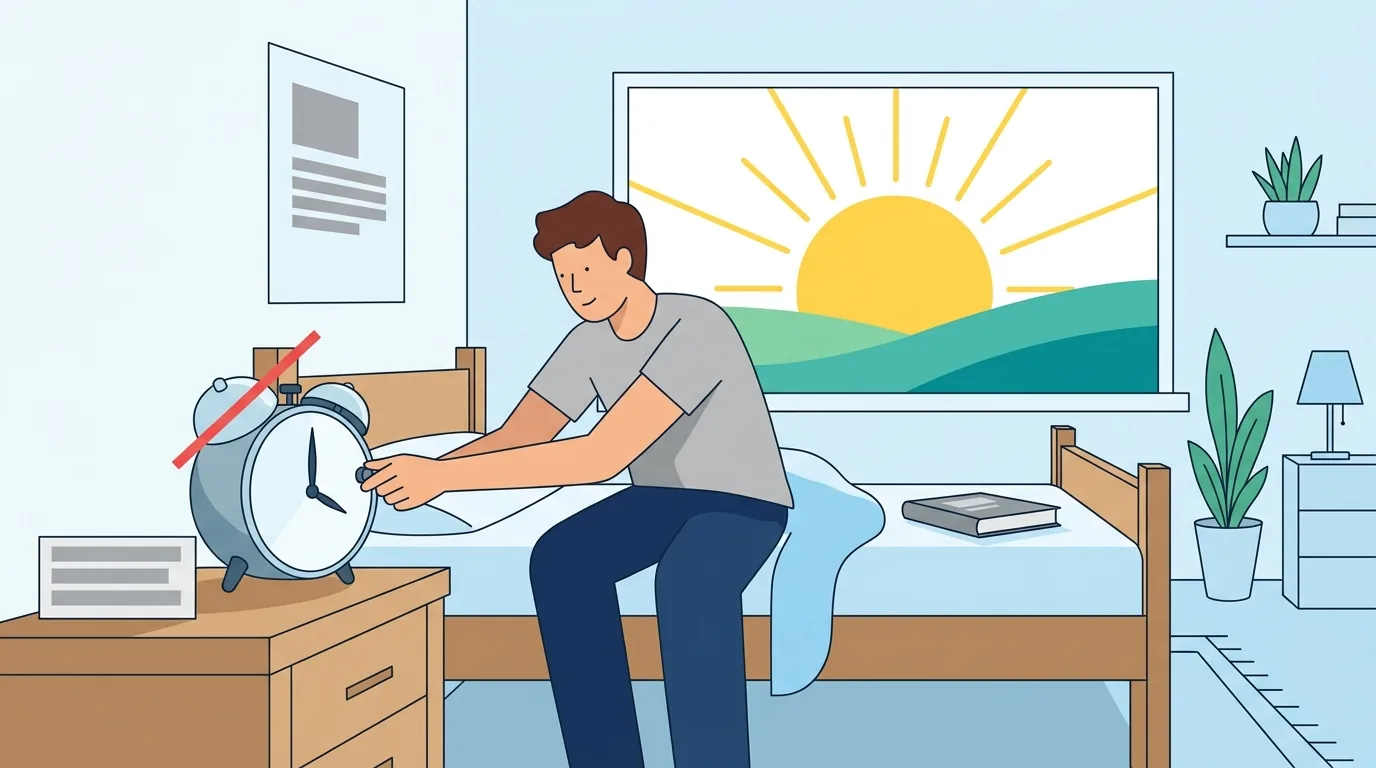
To stop hitting snooze, set one alarm for the time you actually need to be up, put the device across the room, turn a light on within a minute, and have a two-minute first task decided the night before. If you still can't get up with that in place, the problem is almost never the alarm. It is usually a night that was too short, and the fix lives at bedtime.
That is the whole method, and the rest of this post is why each piece is there and what to do when it fails. This is general information about sleep habits, not medical advice. If you sleep a full night and still can't wake up, or you feel unrefreshed every day, that is a conversation for a doctor, not an alarm setting.
Why do you keep hitting snooze?
Two different problems wear the same costume, and mixing them up is why most advice fails.
Problem one: the alarm is negotiable. If your alarm is set for 6:00 but you really need to be up at 6:30, some part of you knows it. The first alarm is a suggestion, the second is the real one, and your brain has learned the whole sequence. You are not weak, you set up a system that rewards snoozing.
Problem two: the night was too short. The urge to go back to sleep is strongest when you haven't had enough of it. Sleep inertia, the groggy, not-quite-here state right after waking, is also worse when you are sleep deprived. We covered how it behaves in why you wake up groggy. No trick beats a short night, because the tiredness is real.
A quick way to tell which one you have: on a weekend or a holiday, when you sleep until you wake on your own, do you feel fine within twenty minutes? If so, you mostly have problem one. If you sleep very late and still feel heavy, you are likely in problem two, and the later sections on bedtime matter more than the alarm setup.
Is snoozing actually bad for you?
Less than the internet says, and not zero.
Researchers at Stockholm University studied this directly. In the first part of their work, 1,732 people answered questions about their morning habits, and many reported snoozing regularly, most often because they felt too tired to get up when the alarm went off. Snoozing was especially common among young adults and evening types. In the second part, 31 regular snoozers spent two nights in a sleep lab, one morning with 30 minutes of snoozing and one with an immediate wake-up. The team found no negative effects of the half hour of snoozing on night sleep, mood or cortisol, and participants did a bit better on cognitive tests right upon waking. The people who snoozed on average slept slightly less and felt more drowsy in the morning than people who never snooze, which fits the "short night" problem above.
There are two honest limits on that result. It included only regular snoozers who find it easy to fall back asleep after each alarm, and the lead author herself noted that snoozing is probably not for everyone. It is also a small lab study, so treat it as a reassuring data point rather than a verdict.
Other sleep-medicine voices lean the other way. A Stanford sleep-medicine psychologist, quoted on the Stanford Lifestyle Medicine site, says snoozing prolongs morning grogginess and teaches your brain to associate the bed with being awake, and recommends getting out of bed within 15 minutes of the alarm and getting some natural light.
Put those together and a sensible reading is this:
- One planned snooze you chose on purpose, on a morning you had slack, is probably harmless.
- A chain of five alarms you fight every day is a symptom. Either the alarm time is a fiction or the night is too short.
- Snoozing is not what you need to fix. The reason you need it is.
That is why this guide doesn't tell you to feel guilty about the button. It tells you to stop needing it.
Why does a fake early alarm backfire?
The most common snooze setup is also the most self-defeating: an alarm at 6:00 for a 6:30 requirement, followed by a "real" one.
It backfires for three reasons.
- It trains you to ignore alarms. Every time the first alarm goes off and nothing bad happens, it gets weaker. The alarm that actually matters inherits the same reflex.
- It chops your last sleep into pieces. The half hour after the first alarm is light, interrupted sleep. You are paying the cost of waking up without getting the benefit of either sleeping or being up.
- It hides the number you really need. If you are always up by 6:30 anyway, your true wake time is 6:30, and your bedtime should be built from that, not from 6:00.
The fix is almost insultingly simple. Work out the latest time you can get up and still do your morning without panic, and set one alarm for that time. If that time feels too late, the answer is a wake time that is actually earlier, chosen on purpose, not a decoy.
If you want to see what that does to your night, put the real wake time into the sleep calculator and look at the bedtime it implies. Our bedtime guide walks through that arithmetic.
How should the alarm itself be set up?
Treat the alarm as a small piece of equipment with four settings: the time, the sound, the distance and the light.
The time: one alarm, set for the real wake time, same time every day as far as your life allows. A steady wake time is one of the two behaviors the Stanford piece names for keeping your body clock in sync, alongside morning light.
The sound: a jarring sound makes you want to silence it as fast as possible, and a fast silence can end in falling back asleep. Wirecutter, drawing on sleep specialists, makes the same point and suggests gentler sounds that build gradually. If you can tell that you shut your alarm off in your sleep, change the sound.
The distance: put the device where you have to stand up to stop it. Stanford's own sample plan for a good morning starts with exactly this, phone out of arm's reach, then out of bed when the alarm goes off. Standing up is half the battle, since once you're upright the decision to go back to bed has to be made again, with the lights on.
The light: switch a lamp on as soon as the alarm sounds, or open the curtains if it is already day. The sleep-inertia research reviews light, caffeine and temperature as the main things you can do after waking, and light is the one that costs nothing. If it is still dark when you wake, a lamp is better than staying in the dark.
On a laptop or desktop, the online alarm clock does the time part of this: one alarm, set once, with the exact countdown showing. If your phone is the problem (it is also the thing you scroll in bed), leave the phone across the room and use whatever device you actually have to stay out of bed.
The one-alarm morning checklist
Print it, or copy it onto a sticky note on the bathroom mirror.
- Real wake time. The latest time you can get up without rushing. No decoy alarms.
- One alarm. Delete the 5:45, the 5:50 and the 5:55. Keep the one that matters.
- Out of reach. Phone, laptop or clock across the room, ideally near the next place you are going (the bathroom or kitchen).
- Light on within a minute. Lamp, curtains, or the bathroom light, whichever is closest.
- A first two-minute task, decided the night before. Fill a glass of water. Put the kettle on. Stretch for two minutes. It has to be small, specific and already decided, because you are making no decisions at 6 AM.
- A bedtime reminder at the other end. A gentle alert 30 minutes before you want to be asleep, so the morning is protected by the evening.
Every item exists to remove a decision. Snoozing wins when you have to decide something while you are groggy. The checklist moves each decision to a moment when you are not.
What should happen in the first two minutes?
The first two minutes are not about productivity. They are about not going back to bed.
The usual trap is "I'll get up when I'm awake enough," which is circular, because you won't feel awake enough until you are up and moving. Instead, make the first action so small that it doesn't need motivation:
- Stand up and walk to the device you put across the room.
- Turn off the alarm and turn on a light.
- Do the pre-decided task: water, kettle, curtains.
Then stay upright. The Stanford guidance is to get out of bed within about 15 minutes of the alarm and get some natural light, which is a generous window, not a sprint. You do not need to be cheerful. You need to be somewhere other than the bed.
The first 20 minutes will still feel slow, because sleep inertia is normal and typically fades over a short while after waking. Give yourself tasks that tolerate a foggy head (showering, making coffee, putting the dishes away) and leave email for later. If you want to know how long to expect the fog to last, the sleep inertia post covers it. Caffeine is one of the reactive options the research reviews, and drinking it early in the morning is reasonable for many people, but keep it away from the afternoon if it interferes with your night.
When is snoozing a sign the night was too short?
If you've set up the one-alarm morning and still can't do it, look at the other end of the night before you buy another gadget.
Signs that bedtime is the lever:
- You need two or three alarms to get up even when you have set a real time.
- You sleep very late on weekends and still feel behind.
- You feel fine for 20 minutes once you are up, but the dread of getting up is intense.
If that sounds like you, the useful move is to go to bed earlier by a small, steady amount and keep the wake time fixed. Shifting bedtime by 15 minutes every few nights is easier to keep up than one dramatic early night. Use the sleep calculator to see what your fixed wake time implies, and set a bedtime reminder so the earlier time actually happens.
Sometimes the cause isn't bedtime at all. Trouble waking is also more common with certain sleep disorders, mood problems and work that forces unusual wake times. If you are sleeping a full night and still can't wake up, or you are drowsy during the day in a way that affects driving or work, talk to a doctor. An alarm setup can't fix a medical cause.
Putting it into practice tonight
Do three things before bed:
- Decide the real wake time and delete every other alarm. For a 6:30 wake time, the 6:30 AM alarm is one click away.
- Move the device across the room and decide your first two-minute task.
- Set a bedtime reminder for 30 minutes before you want to be asleep.
Tomorrow, when the alarm goes off, you have exactly one job: stand up and reach it. Everything after that is already decided.
Ready to try it? Set one alarm for the time you actually need on the online alarm clock, delete the rest, and see how the first week feels.
FAQ
How many times is it okay to hit snooze?
There is no number that is medically correct for everyone. In the Stockholm University lab study, regular snoozers who were allowed 30 minutes of snoozing showed no negative effects on night sleep, mood or cortisol, but that group found it easy to fall back asleep and the authors said snoozing is probably not for everyone. A practical rule is one planned snooze at most, on a morning when you have the slack. If you need several, the alarm time is probably not your real wake time, or the night was too short.
Why do I feel worse after snoozing?
Often it is sleep inertia, the groggy state right after waking. Sleep inertia is a normal transition and tends to be worse when you are sleep deprived. Repeated alarms mean repeated wake-ups, and some people feel the grogginess each time. Others, like the regular snoozers in the Stockholm study, don't. If you consistently feel worse after snoozing, that is a good reason to stop for a week and see what happens.
Does putting the alarm across the room work?
For most people it helps, because it forces you to stand up and walk, and being upright with the lights on makes going back to bed a new decision. Sleep experts quoted by Stanford and Wirecutter both suggest it. It won't fix a short night, but it removes the easiest way to silence the alarm without waking up.
Should I set multiple alarms?
If you do, make each one mean something. A single honest alarm is usually better than a ladder of five, because a ladder teaches you that the first four are optional. If you worry about missing the single alarm, check it the night before, keep the volume up, and use a backup device for the same time rather than a series of earlier ones.