
Five-Minute Break Ideas That Actually Restore
By Mark Fulton · 2026-09-10 · 15 min read
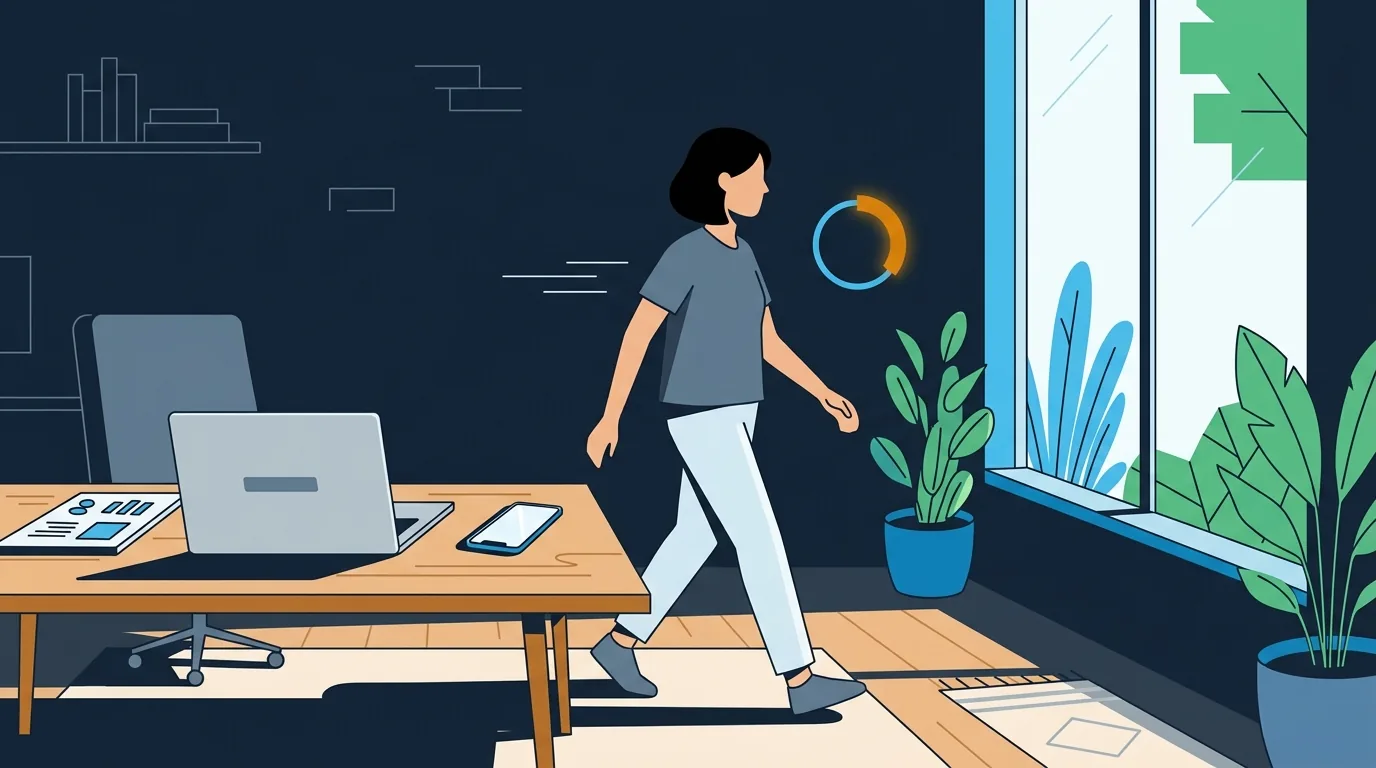
Five minutes is enough to restore something. It is not enough to restore everything, which is the whole reason the choice matters.
Pick the break by what the last work block drained, not off a list. Desk work depletes three separate things and each needs a different break: attention, which comes back when you stop taking in new information and let your eyes look at something far away; the body, which comes back when you stand up, move and change posture; and mood, which responds to daylight, to a minute of contact with another person, or to something that makes you laugh. A fourth thing, momentum, is never restored by a break at all, only protected, by leaving yourself a note about where you were before you stand up. The reason "quick look at Slack" is the most common five-minute break and one of the worst is that it restores none of the three. It is more incoming information aimed at the exact system that just ran out. And the break needs its own timer, because an untimed five-minute break is a twelve-minute break with a story attached to it.
The lists of break ideas floating around are not wrong. Stretch, hydrate, walk, breathe: all fine. The problem is that they are unsorted, so thirty-four ideas all look equally good and you end up picking whichever one is closest to your hand, which is the phone. Sorting them by what they restore turns a list into a decision you can make in three seconds while standing up.
Why do most five-minute breaks fail?
Three ways, and they are all avoidable.
The first is that no decision gets made. The block ends, you are still sitting down, and the default action for a seated human with a screen in front of them is to look at the screen. By the time you have decided what the break should be, ninety seconds are gone and the break has already become a scroll.
The second is overrun. A five-minute break that runs to twelve does not just cost seven minutes. It costs the seven minutes plus the re-entry, and re-entry into demanding work is the expensive part. This is the same problem that makes a calendar block quietly stretch from ninety minutes to three hours, and it has the same fix: something outside your own judgment has to say when it is over.
The third is the one nobody names. The break is the same class of activity as the work. If the block was reading, thinking and typing, then reading messages, thinking about messages and typing replies is not a break from anything. It is the same work with worse inputs.
It is worth being straight about what the evidence supports here, because break advice tends to get oversold. The best current summary is a meta-analysis of micro-breaks, Give me a break! by Albulescu and colleagues in PLOS ONE, pooling 22 samples across 19 publications and 2,335 participants. Short breaks produced small but consistent gains in vigor and reductions in fatigue. The overall effect on task performance was not statistically significant. Two details in the analysis matter more than the headline: longer breaks did better on performance than shorter ones, and for cognitively demanding tasks specifically the performance effect of a micro-break was essentially zero.
Read plainly, that says a five-minute break reliably changes how you feel and does not automatically change what you produce, and that the harder the work, the less a very short break can do for the output. That is an argument for taking the longer break seriously, and for not expecting five minutes to reset a brain that has been doing hard work for an hour. It is not an argument for skipping breaks. Feeling less fatigued at 4pm is worth having on its own.
What are you actually trying to restore?
Ask one question before you stand up: what ran out?
Attention ran out if you have read the same paragraph three times, if you keep tabbing away without deciding to, or if the work has turned into typing rather than thinking. The tell is that effort is still available but aim is not.
The body ran out if you notice your shoulders, your lower back, your hip flexors or your eyes before you notice your concentration. Ninety uninterrupted minutes in a chair is a physical event, not just a cognitive one.
Mood ran out if you are still able to work but have become curt, flat or irritable about it. This is the one people are worst at diagnosing in themselves, and it is usually the reason a perfectly good afternoon falls apart.
Momentum is different. It has not run out, it is about to be dropped. If you are mid-thought when the bell goes, the risk is not that the break fails, it is that the next block starts with ten minutes of reconstructing where you were.
Here is the menu, sorted by which of those it addresses. The minute costs are realistic rather than optimistic, and the last column is the part every break list leaves out: where each one tends to run long.
Attention: no new input, and let your eyes go long
| Break | Realistic minutes | Where it goes wrong |
|---|---|---|
| Stand at a window and look at the furthest thing you can see | 1 to 2 | Nothing goes wrong. This is the cheapest item on the whole list and the one people skip |
| Walk to the far end of the building, or the end of the garden, and come back | 3 to 5 | Taking the phone. If the phone comes, this becomes a scroll with steps in it |
| Make tea or coffee and read nothing while the kettle runs | 4 to 5 | The waiting minute is the valuable part. Filling it with a screen removes the reason it worked |
| Sit with your eyes closed, no audio, counting breaths | 2 to 5 | Drifting into planning the next block. Counting gives the mind a job that is not planning |
| Wash your face, or your hands, slowly | 1 to 2 | Rarely overruns, which is why it is useful when the schedule is tight |
| Step outside with no destination | 3 to 5 | Weather. Keep an indoor version so the habit does not depend on the sky |
Body: stand up, change shape, move blood
| Break | Realistic minutes | Where it goes wrong |
|---|---|---|
| Full range shoulder rolls, neck turns, a hip hinge, ankles | 2 | Doing it seated. Half the point is leaving the chair |
| Ten to twenty bodyweight reps: squats, push-ups, calf raises | 2 to 3 | Going hard enough to sweat, which has a real cost in an office and a shower cost at home |
| Carry something upstairs and come back down | 3 to 4 | Finding a second thing to carry. One trip |
| Lie on the floor with your calves on a chair | 5 | The single easiest item here to overrun. It feels excellent. Time it |
| Refill the water bottle and actually drink some of it | 2 | Refilling it and putting it down full, which is the usual outcome |
Mood: daylight, other humans, something that is not the task
| Break | Realistic minutes | Where it goes wrong |
|---|---|---|
| Message or call someone for one specific reason | 4 to 5 | The highest overrun risk on the list. A conversation has no natural five-minute edge, so decide the end before you start |
| Stand in daylight, outdoors if possible | 3 to 5 | Checking the phone while you stand there, which cancels the attention benefit even though the mood benefit survives |
| Play one song and do nothing else | 3 to 4 | Nothing much. The song carries its own timer, which is exactly why it works |
| Water the plants, or tidy one surface, or greet the dog | 2 to 5 | Tidying expands to fill any container. Name one surface before you start |
| One page of a paper book | 4 to 5 | Work reading. Fiction has an end of page, a report does not |
Momentum: protect it before you stand up
| Break | Realistic minutes | Where it goes wrong |
|---|---|---|
| Write the next sentence, then leave it unfinished | 1 | Doing it after the break instead of before, when the thread is already gone |
| Note where you were and what the next move is | 1 | Writing a summary of what you did. Write the next move, not the last one |
| Leave the file open on the exact line | under 1 | Closing everything tidily, which is how you lose the position |
| Say the next step out loud | under 1 | Feeling silly. It works anyway |
The four groups are not exclusive. A walk outside without the phone hits attention, body and mood at once, which is why walking outranks almost everything else and why every break list has it. The groups are there for the days when a walk is not available and you need a substitute that targets the right thing.
Which breaks restore attention rather than drain it?
The distinguishing feature is not relaxation. It is the absence of new information.
Anything that hands you fresh things to process, judge or reply to keeps the same machinery running. Anything that gives your attention nothing to grip, a window, a hallway, a closed pair of eyes, a repetitive physical action, lets it idle. That is the practical difference between staring out of a window for two minutes and reading two minutes of headlines, and it is much bigger than it looks.
Your eyes have their own version of this. The American Academy of Ophthalmology's guidance on eye strain is the 20-20-20 rule: every 20 minutes, shift your eyes to look at an object at least 20 feet away for at least 20 seconds. The same page is reassuring about the stakes, stating plainly that eye strain does not injure the eye and does not cause permanent damage. It is a comfort problem, not a damage problem.
The honest footnote is that the specific numbers in that rule are not well supported by trials. In 20-20-20 Rule: Are These Numbers Justified?, published in Optometry and Vision Science in 2023, Johnson and Rosenfield had 30 participants perform a 40-minute demanding reading task on a tablet on four separate occasions, with 20-second breaks every 5, 10, 20 or 40 minutes. Symptoms rose significantly in every condition, and the scheduled breaks made no significant difference to symptoms, reading speed or accuracy. Their conclusion was that 20-second scheduled breaks are not supported as a treatment for digital eye strain.
That is a useful result, and the useful reading of it is not "breaks do not work." It is that 20 seconds is too small a dose to test. A five-minute break in another room gives your eyes fifteen times that, at variable distances, while the rest of you does something else. If you are taking real breaks, the 20-20-20 rule is a nice thing to do in the middle of a block and not the thing you are relying on.
Why does a screen break rarely count?
Because a screen break is usually a cognitive activity, and cognitive activities are the one category with evidence against them.
A diary study by Kim, Park and Niu, Micro-break activities at work to recover from daily work demands in the Journal of Organizational Behavior, followed 86 office workers across ten consecutive workdays and sorted their micro-breaks into four categories: relaxation, nutrition intake, social, and cognitive. Relaxation and social breaks buffered the link between work demands and negative mood at the end of the day. Nutrition intake on its own did not do much. Cognitive break activities made that link worse, not better.
One diary study with 86 people is not the last word on anything, and the categories are broader than "checking Slack." But the direction matches what everyone already suspects about their own phone, and it lines up with the meta-analysis finding that micro-breaks do least for performance on exactly the cognitively demanding work that a message check most resembles.
There is a second, plainer problem with the screen break: it does not end. Every other item in the menu above has a natural edge. The kettle boils, the song finishes, the page ends, you arrive back at your desk. A feed is built specifically not to have one, which is why the five-minute version reliably becomes the fifteen-minute version and why it is the one break you genuinely cannot run untimed.
If you want the phone for a legitimate reason during a break, a paced breathing session is one of the few uses that stays inside its box, because the pattern itself sets the length. Our guide to box breathing and the other common patterns covers how to pick a count you can hold, and the session ends when the timer says so rather than when you feel finished.
How long should the longer break be?
Longer than the short one by a meaningful multiple, and used differently.
The classic structure is a longer break after every fourth block, and the usual advice is 15 to 30 minutes. The meta-analysis gives that structure real support: across the studies pooled, longer breaks produced better performance outcomes than shorter ones, and the performance benefit of a micro-break on cognitively demanding work was negligible. If your work is the demanding kind, the long break is where the recovery you can actually measure is going to come from. The short ones are keeping your fatigue and vigor in decent shape between the long ones.
What goes in it matters as much as the length. A long break that is three short breaks joined by twenty minutes of feed is a worse version of a short break. The things that seem to justify the extra minutes are the ones a five-minute window cannot fit: leaving the building, eating something properly, a real conversation, daylight for long enough to notice it, or lying down.
The ratio question, how much break per unit of work, has its own answer and it is less settled than the confident versions online suggest. We went through where the popular numbers come from in the 52/17 rule, including why the same source later produced different ratios. The short version: the ratio is a starting point to test on yourself, not a law to obey.
Should the break itself be timed?
Yes, and it is the half people leave manual.
Almost everyone running focus blocks times the work carefully and then eyeballs the break. That is exactly backwards relative to which one goes wrong. The work block has a task in it that is pulling you along. The break has nothing pulling you anywhere, which is why it drifts. Timing the break is not about discipline for its own sake. It is about being able to lie on the floor for five minutes without spending any of them wondering how long you have been there.
A timed break also removes the negotiation. If the break ends by itself, you do not have to decide to go back, and not having to decide is most of the value. This is the same reason a timed work block is easier to start than an open-ended one: the boundary does the deciding.
Two practical setups. If you are running blocks anyway, let the pomodoro timer run both halves, so the break starts automatically when the block ends and ends automatically when the break is over, including the longer break after the fourth round. If you are not running blocks and just want to step away from something for five minutes, a plain 5 minute timer does the job with less ceremony.
Either way, the useful move is to make the choice before the break starts rather than after. Look at what ran out, pick the row from the menu that matches it, and let the clock end it. The break you decide on while standing up is almost always better than the one your hand decides for you.
Let the pomodoro timer time the break as strictly as it times the work, and see how different a five-minute break feels when it is genuinely five minutes.
Frequently asked questions
Is checking your phone a real break?
It is a break from the task and not much of a break for you. It swaps one stream of information for another, which is why it leaves attention roughly where it found it, and the diary evidence on cognitive micro-break activities points the wrong way. It is also the only common break with no natural ending, so it overruns more than anything else on the menu. If you need the phone during a break, give it a job with a defined end: one song, one paced breathing session, one message you already intended to send. Then put it down.
Should you leave the room during a break?
If you can, yes, and it is the single highest-value change on this list. Leaving the room changes what your eyes are focused on, changes your posture, usually adds daylight or at least different light, and puts physical distance between you and the thing you were doing. That is three of the four restore targets in one action. It also makes overrunning less likely, because coming back to the desk is an unambiguous end to the break, where a break taken in the chair has no edge at all.
What's the best break after four pomodoros?
Something longer and structurally different, in the 15 to 30 minute range, spent away from the desk. The research on break length points the same way: longer breaks did more for performance than short ones, and short breaks did least on demanding cognitive work. Eat, walk, get outside, talk to someone, or lie down. Save the small stuff for the five-minute gaps. What does not work is treating the long break as a longer version of a screen check, which converts the one break with real recovery potential into the one that leaves you flatter than when you started.
Does a break need to be exactly five minutes?
No, and the exact number matters far less than having one at all. Five minutes is a reasonable default because it is long enough to stand up, move and look at something distant, and short enough that you will actually take it. If your blocks are longer, the break usually wants to be longer too. The thing worth being strict about is not the figure, it is that the break has a defined end that is not your own judgment halfway through it. A break with a fixed length you chose in advance beats a break of the theoretically correct length that you end by feel.