
The 52/17 Rule: Does the Work-Break Ratio Hold Up?
By Mark Fulton · 2026-08-12 · 11 min read
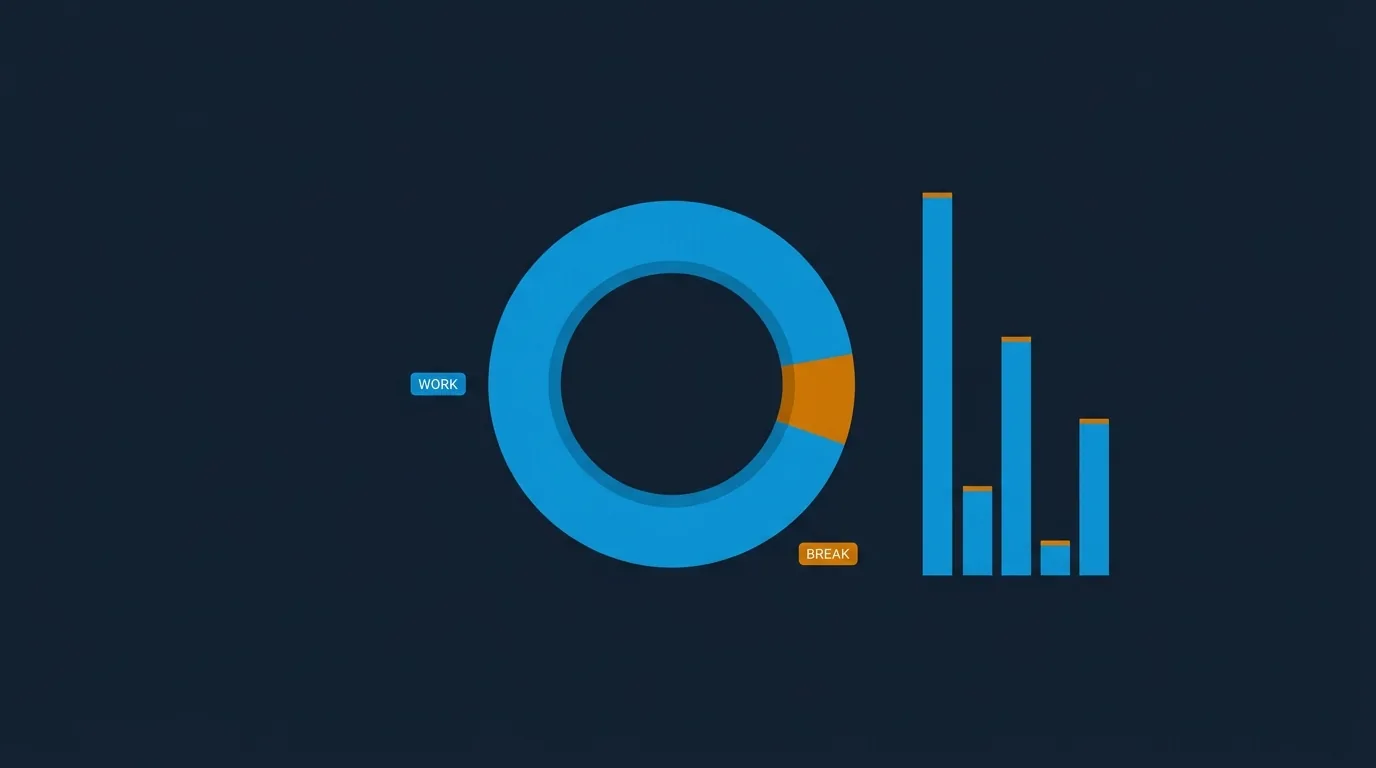
The 52/17 rule says the optimal working rhythm is 52 minutes of focus followed by a 17-minute break. It gets repeated as if a lab established it. No lab did. The 52/17 ratio comes from a single time-tracking company, DeskTime, describing the average computer-usage pattern of the top 10% of its own users in a 2014 internal analysis — observational telemetry from one app's power users, not a controlled study — and the same company's later re-runs of that analysis produced 80/17 and then 112/26. The number moved because the conditions moved. That is the most useful fact about it, and it is the one nobody repeating the rule mentions.
None of which makes 52/17 useless. A fixed work block with a real break in it is a good default, and the break research behind it is stronger than the block length. But you should know which half is evidence and which half is one vendor's chart.
Where does the 52/17 number come from?
DeskTime is employee time-tracking software. It runs on a computer, classifies which applications and websites the user is on as "productive" or not, and logs the time. In 2014 the company looked at its own database, isolated the users with the highest ratio of productive-application time — its stated framing is an analysis of "the top 10% of the most productive people" — and looked at how their working day was shaped. The pattern it reported: roughly 52 minutes at the keyboard, then roughly 17 minutes away.
That is the whole provenance. There is no experiment, no control group, no random assignment, no peer review, and — on DeskTime's own page — no disclosed sample size. Every blog post, business-school article and LinkedIn carousel that has since called 52/17 "the scientifically proven work-break ratio" is describing one company's product analytics.
To be fair to DeskTime: it has never claimed otherwise, and its own 2024 update on the rule is fairly candid that the figure came from its user data and has since changed. The over-claiming happened downstream, in the aggregators that turned "our users averaged this" into "research says this."
Is it research or one company's app data?
App data, and the distinction matters in three specific ways.
The population is self-selected twice over. These are people who chose to install productivity-tracking software, and then the top decile of them by that software's own productivity metric. Knowledge workers at desks, mostly on tasks a tracker can classify. Nurses, teachers, machinists, parents, and anyone whose work is not a laptop do not appear in this dataset at all.
The metric defines the finding. DeskTime's "productive" score is time in applications the tracker counts as productive. A person who reads a printed contract for 30 minutes registers as idle. A person who leaves a document open while thinking registers as productive. The 52-minute figure is partly a measurement of how software sees work, not how minds do.
It is a correlation with the arrow unassigned. Suppose the finding is completely real. It still does not tell you whether the 52/17 rhythm made those people productive, or whether people who happen to have productive jobs — few meetings, high autonomy, uninterrupted calendars — naturally fall into hour-ish blocks. The second reading is at least as plausible as the first, and adopting the ratio would not transfer the job conditions along with it.
That is the honest ceiling of this kind of data: it is a good description of what some people did, and a weak basis for what you should do.
Why did the same study later say 112/26?
Here is the part that almost never travels with the rule. DeskTime has re-run the analysis, and the answer keeps moving:
| When | Reported ratio | Context |
|---|---|---|
| 2014 | 52 / 17 | Original analysis of the top 10% of users |
| February 2020 | 80 / 17 | Immediately pre-pandemic |
| 2021 | 112 / 26 | Same analysis, re-run after remote work became normal |
Three runs of the same methodology on the same platform, three different "optimal" ratios — and the work block more than doubled in seven years. If 52 minutes were a property of human attention, it would not have become 112 minutes because people started working from a spare bedroom.
The far more likely reading is that these numbers measure interruption environments, not brains. In an open-plan office in 2014, roughly an hour was about as long as anyone got before something intervened. At home in 2021, with no desk visits and no commute, blocks stretched. The metric tracked the office, then tracked the house.
So the correct summary of DeskTime's decade of data is not "work 52 minutes." It is closer to: highly productive people work in long uninterrupted stretches and then genuinely stop, and the length of the stretch is set by their circumstances. That is a real and useful observation. It just is not a number you can wear.
Which ratio fits the work you actually do?
Different ratios solve different problems. Startup cost, task type and break feasibility matter more than any specific pair of numbers. Here is the honest comparison:
| Ratio | Suits which work | Break feasibility | What actually backs it |
|---|---|---|---|
| 25 / 5 | Dreaded tasks, admin, procrastination, studying with recall gaps, ADHD-friendly restarts | Very easy — 5 minutes is a stretch and a glass of water, no planning needed | A convention from Cirillo's 1980s method, not a study; the scheduled-break half has meta-analytic support |
| 50 / 10 | General knowledge work; the practical default for most desk jobs | Easy — long enough to leave the room, short enough not to derail | No specific study; a middle ground between the block lengths people actually sustain |
| 52 / 17 | Solo deep work with a protected calendar and no fixed meeting grid | Moderate — 17 minutes is real recovery, but awkward against clock-aligned meetings | One time-tracking company's 2014 user telemetry. Not a controlled study, not replicated externally |
| 90 / 20 | Writing, coding, analysis, anything with a long warm-up before it gets good | Harder — needs a workplace where you can be gone 20 minutes without cost | Popularised from ultradian-rhythm arguments; the underlying sleep-cycle research does not translate cleanly to waking task performance |
| 112 / 26 | Sustained solitary projects, remote work, days with nothing scheduled | Hardest — nearly two hours without a break is unworkable in most jobs, and hard on eyes and posture | The same DeskTime analysis, re-run in 2021. Same limits as 52/17, plus it contradicts occupational-health advice on screen breaks |
Two things worth noticing in that table. First, the evidence column is thin everywhere — no ratio in common circulation is backed by a controlled trial establishing it as optimal. Second, the feasibility column is where the actual differences live. A ratio you cannot take the break in is not a ratio, it is a work block with a guilt trip attached. We went through the same question for the 25-minute number in what the research actually says about the pomodoro technique — the conclusion generalises: the fixed block is the useful part, the specific length is a convention you are allowed to tune.
It is also worth saying that longer is not automatically more serious. UK occupational-health guidance for screen work is explicit that short frequent breaks beat long infrequent ones, recommending something on the order of 5 to 10 minutes every hour rather than 20 minutes every two hours. A 112/26 day is a long way from that.
What makes a 17-minute break work or fail?
The break length is the half of 52/17 with actual research near it — just not research about 17 specifically.
A 2022 systematic review and meta-analysis in PLOS ONE, Albulescu and colleagues' "Give me a break!", pooled 22 study samples covering roughly 2,300 participants. Micro-breaks produced small but consistent improvements in vigor and reductions in fatigue. Effects on task performance were not significant overall — but break duration was a moderator, with longer breaks associated with more performance benefit, and the authors noted that recovering from highly depleting tasks likely needs more than ten minutes. That is a genuine point in favour of a longer break after a longer block, and it is the strongest thing that can be said for the 17 in 52/17.
There is also evidence that stepping away is about goal maintenance rather than refuelling. Ariga and Lleras's 2011 Cognition paper, on brief mental breaks and vigilance decrements, found that participants who briefly switched to a secondary task during a 50-minute vigilance task showed no performance decline, while those who did not, did. Their interpretation was that sustained attention fails through habituation to an unchanging goal, and briefly deactivating and reactivating the goal prevents it. That is a mechanism a break can satisfy in a couple of minutes — and one that a break spent staring at the same screen cannot satisfy at all.
Practically, a 17-minute break works when it is a real change of state: leave the desk, change what your eyes are focused on, move, get outside if you can. It fails in three familiar ways — it becomes a Slack check (that is a task switch, not recovery), it becomes a phone scroll that ends at 40 minutes, or it never starts because you were mid-thought at minute 52. Set the break on a timer too. An untimed break is the most common failure mode of every one of these systems.
One caveat that belongs in any post like this: if you are exhausted every afternoon regardless of how you schedule the day, the ratio is not the variable. Persistent fatigue, an inability to concentrate that is new for you, or sleep that never restores are worth raising with a doctor rather than solving with a timer. Interval tuning is for a working system, not a broken one.
How do you test a ratio on yourself in two weeks?
Nobody can tell you your number from a dataset you are not in. But you can get a defensible answer for yourself in ten working days.
Days 1–2 — baseline, change nothing. Work as you normally do. At the end of each day, write down three things: how many blocks of genuinely uninterrupted work you got, the longest one, and a 1–5 rating of how you felt at 4pm. This is your control condition, and skipping it is why most people's self-experiments prove nothing.
Days 3–7 — run 52/17. Four blocks a day, minimum. Set both timers — the 52 and the 17. Break rules: stand up, leave the desk, no work applications, no work chat. Log the same three numbers each evening, plus one line on where the ratio broke (a meeting at the half hour, a block you had to cut at 40 minutes, a break you skipped).
Days 8–12 — run your contrast. Pick the ratio your first week's notes point at. If you were repeatedly hitting flow right as the timer went, run 90/20. If you kept abandoning blocks before minute 52, run 25/5 or 50/10 and see whether completion rate rises. Same logging.
Day 13 — read your own notes, not the internet's. Compare the two weeks on three measures: number of completed blocks, subjective 4pm energy, and how often you actually took the break. That last one is decisive. The best ratio for you is the longest one whose break you reliably take, in the calendar you actually have.
Two rules that keep this honest. Change one variable at a time — do not start a new ratio and a new caffeine schedule in the same week. And judge on completed blocks, not hours logged; hours are an input, finished blocks are the closest thing to an output you can count.
Start the experiment now rather than reading another post about it. Open the countdown timer, dial it to 52 minutes, and run one block — then reset it to 17 for the break, so both halves are actually timed. If you would rather have the phases advance for you, the pomodoro timer runs the classic 25/5 pattern with automatic breaks and a session count for the day, with custom block lengths coming to Pro. And if 52 feels arbitrary — it is — the one-click 45-minute timer is a perfectly respectable place to start. Every timer on this site is free, no account, no download.
FAQ
Is the 52/17 rule scientifically proven?
No. It originates from a 2014 internal analysis by DeskTime, a time-tracking company, describing the average computer-usage pattern of the top 10% of its own users by its own productivity metric. There was no control group, no random assignment, no peer review, and no published sample size. It is observational data about one app's users, and it has not been independently replicated. The general principle that scheduled breaks help is better supported than this particular pair of numbers.
Is 52/17 better than the pomodoro technique?
Neither has evidence establishing it as superior — both block lengths are conventions rather than findings. The practical difference is startup cost versus depth. A 25-minute pomodoro is easier to begin, which makes it better for tasks you are avoiding, for studying, and for fragmented days. A 52-minute block gives more room for work with a long warm-up, and its longer break has slightly better support in the micro-break literature. If you procrastinate on starting, use the shorter block. If you resent being interrupted mid-flow, use the longer one.
What should you do during a 17-minute break?
Change your state, not your screen. Leave the desk, look at something far away, move — a short walk, stairs, stretching — and get outside or near a window if you can. Water and a snack count. Checking Slack, email or your phone does not: that is a task switch, and the research on breaks depends on actually disengaging from the task goal. Set a timer on the break too, because the failure mode of a good break is that it quietly becomes 40 minutes.
Can you use 52/17 for studying?
You can, but it is often the wrong size for it. Studying benefits from retrieval practice and spacing, which means more frequent stopping points rather than fewer — a 52-minute block can pass without you ever testing whether anything stuck. A common compromise is a 50-minute study block broken by a two-minute self-quiz at the halfway mark, then the full break. If you are studying material you find hard to start on, shorter blocks generally win: the block you actually begin beats the ideal block you postpone.