
How to Use a Chess Clock: Setup, Etiquette, First Game
By Mark Fulton · 2026-10-19 · 11 min read
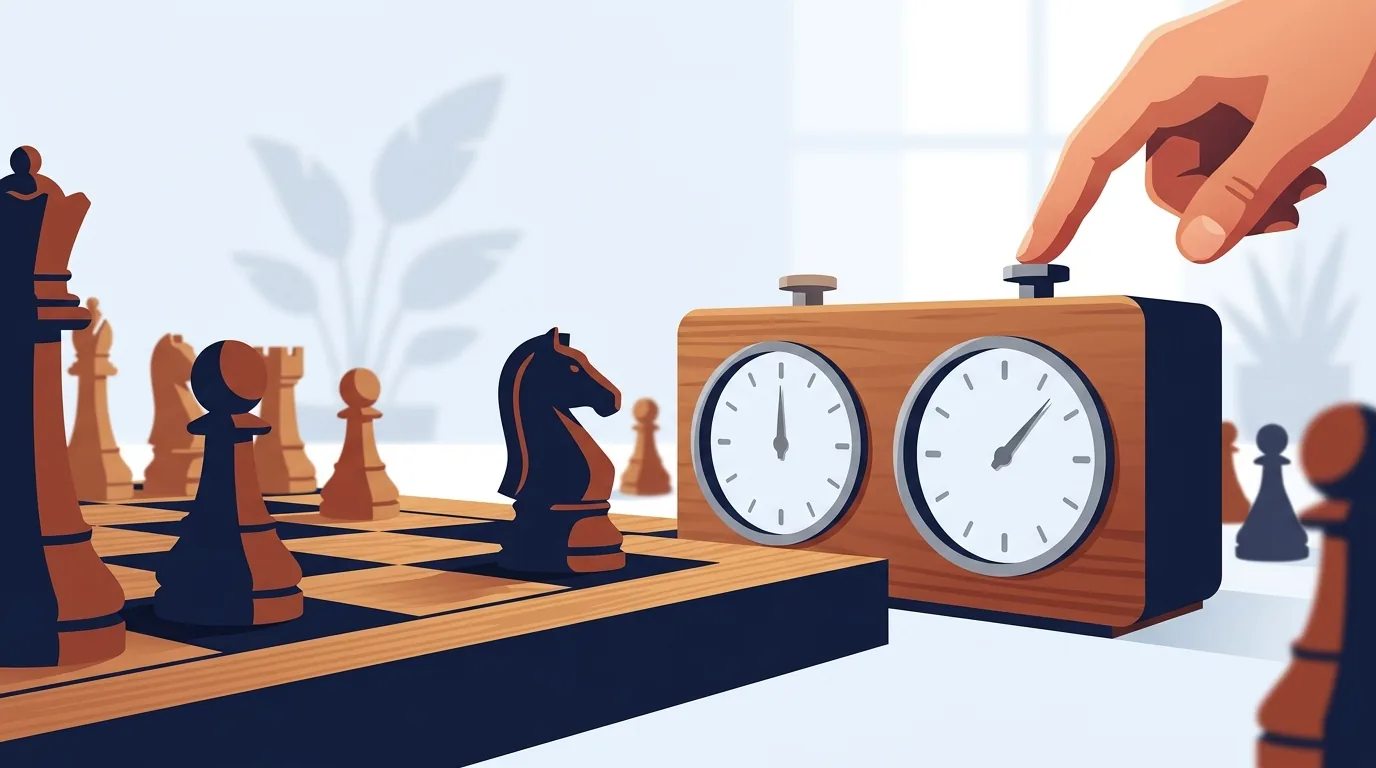
A chess clock is two timers in one box where only one can run at a time. Set the same time on both sides, put the clock where Black wants it (usually on Black's right), and have Black press the button on Black's side to start White's clock. White moves, then presses the button on White's side with the same hand that moved the piece, which stops White's time and starts Black's. Every move ends with a press, and if your time hits zero before the game ends you lose on time, unless your opponent has no possible way to checkmate you. That is the entire mechanism. The rest of this post is the part nobody explains: the order of operations before the first move, the handful of habits that stop arguments, and how the official rules and the casual-club conventions differ.
If you are about to play your first timed game, read the checklist in the second half and set your clock on the free chess clock before you sit down. It takes about two minutes and you will feel like you have done this before.
Where does the clock go and who starts it?
The clock sits beside the board, on the side of one player's hand, so that both players can reach it without leaning across the pieces. In a tournament that is the arbiter's call. FIDE's Laws of Chess say that before the game starts the arbiter decides where the chessclock is placed. In a casual game nobody is deciding, and the common convention is that the player with the Black pieces picks the side. In practice that means the clock goes on Black's right, which puts it on White's left.
Starting is where beginners get tangled. The official wording is simple: at the time set for the game to start, White's clock is started. The everyday way to do that is for Black to press the button on Black's side. That press stops Black's clock (which had not been running) and starts White's. White then thinks, moves, and presses the button on White's side. So a game begins with a press from the player who has not yet moved. If you are White and you sit down and start thinking before your clock is running, nothing is being counted, which is exactly why a fair start matters.
On a phone or laptop it works the same way. On the chess clock you tap the side of the player who is not moving first, and the other side begins counting.
How do you set a time control?
A time control is the amount of time each player gets, written as base time plus an optional bonus. The base is for the whole game, per player, so a 10 minute game means each side has 10 minutes and the whole game can run to about 20.
Setting it is three decisions:
- Base time. Both players get the same amount unless you are deliberately giving a handicap.
- Whether to add a bonus per move. Written "10+5", it means 10 minutes plus 5 seconds added each move. If you have never used one, the full mechanics are in increment vs delay explained, and for a first game the short version is that a small bonus keeps a won endgame from being decided by a scramble.
- Check both sides read the same. Before the first press, look at the two displays and say the numbers out loud. A clock set wrong is the most common cause of a restarted first game.
If you are using a physical analog clock, the old trick is to set the hands short of the hour so the flag falls at exactly 6:00. For a 30 minute game with 15 minutes a side, set both clocks to 5:45. Digital clocks skip all that and count down from the number you type.
Which hand should press the clock?
The hand that made the move. FIDE's Laws of Chess state this directly: a player must press the clock with the same hand that made the move, and it is forbidden to keep a finger on the clock or to hover over it. The same article says the move is completed when the clock is pressed, and that the time between making a move and pressing is part of the time allotted to the player. It also says to handle the clock properly: no pressing it forcibly, picking it up, pressing before moving, or knocking it over.
Two practical consequences:
- Move, then press. Never the other way around. Pressing before the move, or pressing without moving at all, is treated as an illegal move under FIDE rules.
- Forgetting to press costs only you. Your clock keeps running while your opponent sits there. They are not obliged to remind you.
US Chess is looser on the one-hand rule outside blitz. A summary comparing the two rule sets in the Greater Peoria Chess Foundation's FIDE versus USCF comparison notes that US Chess has no explicit rule requiring one hand for the move, though a director can penalise pressing the clock without moving. Do not lean on that gap. Playing one-handed costs you nothing and no one at any club will argue with you about it.
What happens when time runs out?
When your time reaches zero, your flag has fallen. On an old analog clock a little red flag actually drops, which is where the word comes from. On a digital clock the display hits 0:00 and usually beeps. Under FIDE rules, a flag is considered to have fallen when the arbiter sees it or when a player makes a valid claim. In plain terms, if you did not complete the game before your time ran out, you lose.
The exception matters more than most beginners expect. FIDE Article 6.9 says the game is drawn instead if the position is such that the opponent cannot checkmate the player's king by any possible series of legal moves. That is why "Can you win on time with only a king?" has a clear answer: no. If all you have is a king against the opponent's flag, you cannot possibly checkmate, so their flag falling is a draw.
The wrinkle sits just above that line. FIDE's test is "no possible series of legal moves", not "no sensible moves". The comparison page linked above gives a real example: a king and a rook against a king and a knight lost on time under FIDE rules, because there is a legal sequence in which the knight side could deliver checkmate with the opponent's cooperation. US Chess rule 14E instead lists specific material situations where a win on time is not awarded, and a king and a lone knight is one of the listed cases. The two systems are close and not identical, so for tournaments, ask the director which rules apply.
Two more points that cause arguments:
- Only the opponent calls the flag. If your time runs out and your opponent does not notice, you do not announce it. In US Chess, only the players may call a fallen flag. Under FIDE rules, an arbiter can call it when they see it.
- Checkmate on the board beats a flag that has not been claimed. If you deliver mate and your opponent's claim of your fallen flag came after, the mate stands. If your time already expired, you lose, even if your next move would have been mate.
What are the etiquette rules nobody tells you?
None of these are in the rulebook as a full list, and all of them keep a casual game friendly:
- Press gently. The rules forbid pressing forcibly. A slap on the button also moves the clock, wobbles the pieces and makes the next player flinch.
- Do not touch the clock at all except to press it (or to stop it and call for help). The clock belongs to neither player.
- Do not touch the pieces when it is not your move. Only the player whose clock is running is allowed to adjust pieces, per FIDE Article 6.2.5.
- Stop the clock only to get help. If a pawn reaches the last rank and there is no queen on the table, a player may pause the clock to find one. FIDE says a player may pause the clock only to seek the arbiter's help, for example when a promotion piece is missing. At a kitchen table, say "pausing for a piece" first, then pause.
- Say "flag" quietly, once, and only about your own game. Announcing a fallen flag in someone else's game is bad form.
- Do not hurry your opponent by hovering. That is both rude and, under FIDE rules, forbidden.
- If the clock looks wrong, stop it and say so right away. FIDE says that if you find the setting is incorrect, either player or the arbiter should stop the chessclock immediately. Waiting until you are losing to complain about it does not work.
Your first timed game: a checklist
Run through this the first few times and it becomes automatic. The left column is what matters under the official rules; the notes flag where FIDE and US Chess are known to differ.
| Stage | Do this | Rule note |
|---|---|---|
| Before | Agree on a time control and say it out loud | FIDE requires the time allowance and any added time to be specified in advance |
| Before | Set both sides to the same time, then read both displays | A wrong setting is easy to fix now and hard to fix after move 12 |
| Before | Put the clock on Black's right, if there is no arbiter | FIDE: the arbiter decides. Casual convention: Black chooses |
| Before | Black presses to start White's clock | FIDE: "White's clock is started" at game time |
| During | Move first, then press, with the same hand | FIDE requires the same hand. US Chess has no explicit one-hand rule outside blitz |
| During | Press gently and let go; do not hover | FIDE forbids hovering and forceful presses |
| During | Pause the clock only to get help | FIDE: pausing is for seeking the arbiter |
| During | Draw offers: make your move, offer, then press | FIDE Article 9.1.2.1 places the offer before pressing |
| End | If a flag falls, the opponent states it | US Chess: only players call a flag. FIDE: the arbiter may as well |
| End | If the flagging player cannot be checkmated, call it a draw | FIDE 6.9 uses "no possible legal series". US Chess 14E lists specific cases |
| End | Stop both clocks when the game ends | A finished game ends when the final move is completed, such as a mate or an accepted draw |
Keep that table on your phone for your first couple of games. By the third game you will not need it.
What time control suits a casual game?
For a first game, pick a time control where the clock helps and does not dominate. Three options that work, from gentlest to sharpest:
- 15+10 (rapid with a generous bonus). Each player gets 15 minutes and 10 seconds added after each move. Plenty of room to think, and no panic at the end. Best for learning where the clock goes while you are still hunting for the right button.
- 10+5. A balanced default. A game usually fits in an evening, and the bonus lets you finish a won endgame without frantic mouse and piece juggling.
- 5+3. Blitz with a cushion. Fast enough that you will use the clock constantly, which is the best way to get used to it.
Avoid starting with 1 or 3 minutes without a bonus. At that speed you spend the game learning the button, not the chess. And skip time controls where you have to think about the total move count unless you are in a tournament that requires them.
If you want to practise the physical motion of the clock, you can even run a quiet drill: set a ten minute game, play ten moves at random, and focus on move, release, press. You will get a feel for the rhythm much faster than from reading about it.
When you are ready, open the free chess clock, choose a preset, set the device between the players, and start. It works as a two-player stopwatch for other turn-based games too, and for timing yourself alone, the same idea applies. If you want the history, the Wikipedia article on the chess clock notes the first widely used chess clocks appeared at the London 1883 tournament, invented by Thomas Bright Wilson of the Manchester Chess Club.
Frequently asked questions
Does black or white start the chess clock?
Under the Laws of Chess, White's clock is started at game time. In practice that means Black presses the button on Black's side, which starts White's clock. Once the game is underway, each player presses their own button after every move.
Do you have to press the clock with the same hand?
Under FIDE's Laws of Chess, yes: the hand that moves the piece must also press the clock, and hovering over the clock is forbidden. US Chess has no explicit one-hand rule outside blitz, but a director can penalise pressing the clock without moving. In a friendly game, using one hand is the easy default.
What happens if you forget to press the clock?
Your clock keeps running while your opponent waits. The time between making a move and pressing the clock counts as your thinking time, so you are paying for the delay yourself. Your opponent does not have to remind you.
Can you win on time with only a king?
No. If a player's time runs out and the opponent has no way to checkmate that king by any legal series of moves, the game is a draw, not a win. FIDE Article 6.9 says so directly, and US Chess has a similar set of exceptions in rule 14E. Make sure you keep mating material in a fast game.