
Chess Clock Increment vs Delay: What Changes
By Mark Fulton · 2026-08-27 · 14 min read
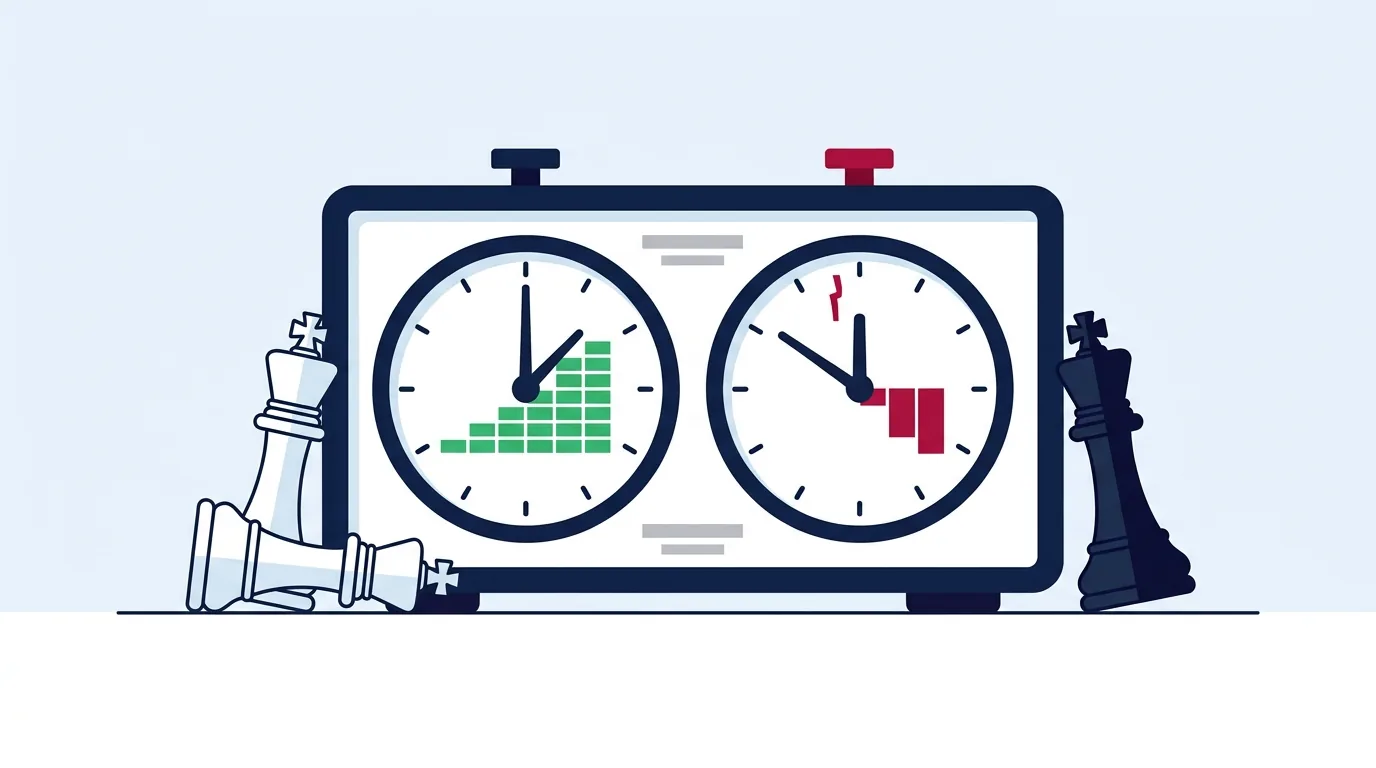
Increment and delay both exist to stop good positions from being decided by a flag, and they do it in opposite ways. Increment is a fixed number of seconds credited to your clock on every move, so if you move faster than the increment, your remaining time goes up. Delay is a fixed number of seconds of grace before your clock starts running at all, so moving fast costs you nothing but never gains you anything either. Your time under delay can hold steady and can fall. It can never rise above where it stood when your move began. That single difference is invisible in the opening and decides the game in a scramble, where a player on 3+2 can grind out twenty extra seconds over ten moves and a player on the same base time with a 2 second delay simply cannot.
That is the whole answer. The rest of this post is the detail: what each mode does mechanically, what the notation on your entry form actually means, how the two behave over ten real moves side by side, and how to set a clock in about fifteen seconds for a casual game.
What is increment in chess?
Increment is extra time added for each move a player makes. The name most people use for it is Fischer increment, after the clock patent Bobby Fischer filed in 1988 and was awarded in 1989, which introduced the idea of a clock that adds time rather than only subtracting it. It reached a wide audience at the 1992 Fischer versus Spassky rematch and was in use at the world championship by the end of that decade.
Worth knowing before you argue about it at a club: the governing definition is broader than the everyday usage. The glossary in FIDE's Laws of Chess defines increment as "An amount of time (from 2 to 60 seconds) added from the start before each move for the player. This can be in either delay or cumulative mode."
Read that twice, because it inverts the conversational meaning. In FIDE's language, "increment" is the umbrella term covering both behaviours, and the two modes underneath it are cumulative mode and delay mode. What players call "increment" is FIDE's cumulative mode. What players call "Bronstein delay" is FIDE's delay mode, which the same glossary describes as: both players receive an allotted main thinking time, each player also receives a fixed extra time with every move, and the countdown of the main thinking time only commences after the fixed extra time has expired.
There is a second wrinkle in that definition, and it is the one that trips people up in forum arguments. FIDE says the time is added before each move. Most digital clocks and every browser clock I know of credit it when you press to end your move, which is the same thing shifted by one press. Over a full game the arithmetic is identical. It only diverges on the move where somebody flags, and on whether you are given the increment for move one. Implementations differ there, so if a scholastic tournament is using a clock you have never seen, press it once at the start of the round and watch what the display does. Ten seconds of checking beats a dispute in time trouble.
For everything below, "increment" means cumulative mode, because that is how the word is used at the board and in every online lobby.
How is delay different from increment?
Delay comes in two flavours that produce identical results and look completely different while you are staring at the clock.
Simple delay, sometimes called US delay, is a countdown before the countdown. Your clock sits frozen for the delay period, then your main time starts falling. Move inside the delay and the display never moves. The delay itself is not shown in your remaining time, so a player on G/30;d5 with 4:12 left genuinely has 4:12 of thinking time plus 5 free seconds per move on top.
Bronstein delay gets to the same place from the other end. The clock counts down immediately, and when you complete your move it gives back the time you actually used, up to the delay amount. Spend 2 seconds with a 5 second Bronstein setting and you get 2 seconds back. Spend 9 and you get 5 back. As Wikipedia's reference article on time controls puts it, the method "adds a fixed amount of time after each move, but no more than the amount of time spent to make the move," which "ensures that the main time left on the clock can never increase even if a player makes fast moves." The practical difference from simple delay is purely one of display: under Bronstein the number on the clock is the time you have available for the next move, and under simple delay the delay is not included in that number.
Here is the full comparison, including plain sudden death for reference.
| Mode | What the clock does on your move | Can your time grow? | What the display shows | Typical notation |
|---|---|---|---|---|
| Fischer increment (cumulative) | Counts down while you think, then credits a fixed number of seconds for the move | Yes. Move faster than the increment and your clock rises | Your true remaining time, which can tick upward after a press | 3+2, 15+10, 40/90+30 |
| Simple delay (US delay) | Waits out the delay period, then counts down your main time | No. It holds steady at best | Main time only. The free seconds are invisible | G/30;d5, G/90;d5 |
| Bronstein delay | Counts down from the first second, then returns the time used up to the delay cap | No. It can return to where it started, never above | Time available for the next move, so it dips and recovers | G/30;b5, or a clock mode labelled Bronstein |
| Sudden death | Counts down. That is the entire mechanism | No | Main time, falling | G/5, 5+0, 3+0 |
Two things fall out of that table. First, simple and Bronstein delay are the same deal with different packaging, so a club that argues about which to use is arguing about a readout, not about fairness. Second, increment is the only one of the four that can hand you time you did not start with, which is why it has quietly taken over serious play.
What does 3+2 or G/30;d5 mean?
Two notation families, from two traditions, and both show up on the same entry forms.
The plus format is online and international. 3+2 is 3 minutes base plus a 2 second increment per move. 15+10 is 15 minutes plus 10 seconds. 1+0 is one minute with nothing added. When you see a slash in front of it, a move count has been attached: 40/90+30 means 40 moves in 90 minutes with a 30 second increment running from move one, after which the next phase begins.
FIDE's own worked example of a multi-phase control, given in the Laws under the definition of time control, is "40 moves in 90 minutes, all the moves in 30 minutes, plus 30 seconds cumulatively from move 1." That is the classical world championship shape: two time buckets and an increment that never stops.
The G format is the US Chess convention. G/30 means game in 30 minutes. The semicolon adds the clock behaviour: G/30;d5 is game in 30 minutes with a 5 second simple delay, and G/60;inc30 is game in 60 minutes with a 30 second increment. The letter after the semicolon is the whole message. d is delay, b is Bronstein, inc is increment.
So G/30;d5 and 30+5 are not the same time control. The first gives each player 30 minutes and 5 free seconds a move that vanish if unused. The second gives 30 minutes and 5 seconds a move that stick around. Over a 50 move game where a player averages 2 seconds on routine moves, that is the difference between finishing with a lot of time and finishing with the time you started with.
How does increment change endgame technique?
Here is where the two modes stop being trivia. Take a rook endgame, both players down to their last half minute, and run ten moves under three settings. Base time at the start of the sequence is 0:30 for everyone. Increment or delay is 5 seconds. The player thinks for these amounts, in seconds: 2, 3, 1, 2, 9, 2, 1, 3, 2, 6. That is 31 seconds of thinking across ten moves, with one long think on move 5 and a final calculation on move 10.
| Move | Seconds used | With 5s increment | With 5s delay | Sudden death, no help |
|---|---|---|---|---|
| 1 | 2 | 0:33 | 0:30 | 0:28 |
| 2 | 3 | 0:35 | 0:30 | 0:25 |
| 3 | 1 | 0:39 | 0:30 | 0:24 |
| 4 | 2 | 0:42 | 0:30 | 0:22 |
| 5 | 9 | 0:38 | 0:26 | 0:13 |
| 6 | 2 | 0:41 | 0:26 | 0:11 |
| 7 | 1 | 0:45 | 0:26 | 0:10 |
| 8 | 3 | 0:47 | 0:26 | 0:07 |
| 9 | 2 | 0:50 | 0:26 | 0:05 |
| 10 | 6 | 0:49 | 0:25 | flag falls |
The arithmetic behind each column is worth stating so you can check it. Under increment, each move costs you what you spent and pays you 5, so a 2 second move is worth plus 3. Under delay, each move costs you the spent time minus 5, floored at zero, so only moves 5 and 10 cost anything at all. Under sudden death, you simply subtract. A Bronstein column would land on exactly the same 0:25 as simple delay, since it hands back the used time capped at 5.
Read across the bottom row. The increment player finished the sequence with more time than they started it with, 19 seconds more, despite one nine second think. The delay player is down 5. The sudden death player is dead in a position they may well have been winning.
That changes what you are allowed to do in an endgame. On increment, a known technical position with a five second bonus is effectively unlimited if you can play the moves in under five seconds each, so learning the Lucena and Philidor positions properly converts directly into wins, and premoving a forced sequence banks time for the moment you need it. On delay, the same knowledge stops you losing but never buys you a cushion, so a long think in a sharp position is a debt you can never repay. On sudden death, technique in the last minute is mostly hand speed, which is why it has been steadily retired from serious over-the-board play.
It also changes what a draw claim means. Under sudden death, the "insufficient losing chances" style claim exists because a player with a fortress can lose on time to nothing. Give the same player a 30 second increment and the problem largely evaporates. They can shuffle indefinitely.
Which time controls count as bullet, blitz, rapid and classical?
The categories are defined by total time, and increment counts toward the total. FIDE's Laws set the boundaries using a formula that assumes a 60 move game.
- Blitz is a game where each player's total is 10 minutes or less, or where the allotted time plus 60 times the increment is 10 minutes or less. So
3+2scores as 3 plus 2 minutes, which is 5, comfortably blitz. - Rapid is more than 10 minutes but less than 60 by the same calculation.
15+10scores as 15 plus 10 minutes, which is 25. Rapid. - Classical, in the sense of a standard-rated game, is governed by the FIDE Rating Regulations, which set a minimum thinking time per player that scales with rating: 120 minutes for 2400 and above, 90 minutes for the 1800 to 2399 band, and 60 minutes when both players are under 1800, all assuming a 60 move game.
- Bullet is not a FIDE category at all. It is an online convention for anything under roughly 3 minutes a side, and it is the reason
1+0and2+1lobbies exist.
The practical takeaway from the 60 times increment formula: adding a 10 second increment to a 15 minute game adds 10 minutes to its official length. A control that feels like a slightly padded rapid game is, on paper, a substantially longer one. If you are running an event and you care which rating pool a game lands in, do the multiplication before you publish the schedule.
How do you set a clock for a casual game?
Fifteen seconds of setup, and the same three decisions every time.
Pick the base time from how long you want to sit there. Two players on 5+0 will be done in about eleven minutes. 10+5 runs closer to half an hour. 15+10 is a real game with real thinking and takes the better part of an hour. If you are fitting chess into a break between work blocks, the same logic you would apply to time blocking your day applies here: pick the control that fits the box, not the one you wish you had time for.
Pick the increment from how much you hate flagging. Zero is fine for a fast game between friends who both like the scramble. Two seconds stops the silliest losses. Five seconds and up means the game gets decided by chess. Beginners should be on five or more, because a game that ends with a beginner staring at a red display having learned nothing is a wasted half hour.
Then hand the device over. The chess clock on this site ships six presets, 1+0, 3+2, 5+0, 10+5, 15+10 and 30+0, running Fischer increment, credited the instant you tap to end your move. Tap the side of the player who is not moving first and the other clock starts, which matches the board convention where Black presses to start White. Lay the phone flat between you, tap your own side when your move is done, and the screen stays awake for the whole game.
The clock keeps a wall-clock reading rather than counting ticks, which is the same design that keeps our countdown timer and stopwatch honest when a browser throttles a page it thinks you are not watching. If that mechanic interests you, the background tab post works through what browsers actually do to a hidden page. For a two-player game on one screen the page is never hidden anyway, so the tap-to-move loop stays exact.
One honest limitation, so nobody is surprised at a club night: the presets here are increment controls, not delay controls. If your club plays G/30;d5, the closest match is a 30 minute preset with no increment, and you keep the 5 second grace as a house convention rather than something the clock enforces. Increment is what nearly every casual and online game uses, so for most people that gap never comes up.
And nothing about the clock is behind a payment. A Pro plan exists, and what it adds is natural-language setup elsewhere on the site, things like typing "timer for pasta" or turning a list of tasks into a blocked-out day. A clock, a timer and an alarm stay free. If you want the plainest possible face for a long game, the full-screen digital clock sits next to it.
Frequently asked questions
Does increment add time before or after your move?
FIDE's Laws define increment as time added before each move. In practice, almost every digital and browser clock credits it when you press to end your move, which produces the same total over the game and differs only on the move where a flag falls and on whether move one gets the bonus. If you are about to play a rated game on unfamiliar hardware, press the clock once before the round and watch which way the display jumps.
Can you gain time with increment?
Yes, and that is the entire point of it. Move in less than the increment and your remaining time rises. In the ten move sequence above, a player on a 5 second increment ended 19 seconds richer than they began. Delay cannot do this. Under both simple and Bronstein delay your main time can hold steady or fall, never climb above where it stood when the move started.
Which is better for beginners, delay or increment?
Increment, and a generous one. Five seconds or more means a beginner in an unfamiliar endgame can think, play, and finish the game rather than lose a drawn rook ending to a display turning red. Delay protects against the same disaster but gives back nothing for playing quickly, so it never builds the cushion a new player needs for the one position they actually have to calculate. Scholastic events often specify delay for historical reasons, so check the entry form before you assume.
What time control should a club game use?
For a weeknight club where people arrive at seven and want to be home by ten, 15+10 or 25+10 gives two real games with genuine thinking time. For a casual meetup, 10+5 is the sweet spot: long enough that the game is about chess, short enough for three or four rounds. Skip zero increment entirely for anything you would be annoyed to lose. If your club is FIDE rating its games, run the 60 times increment arithmetic first so the control lands in the pool you intended.
Set the increment, lay the phone between you, and play. The chess clock is loaded with all six controls discussed here, and if you would rather split the evening between chess and something else, the 25 versus 50 minute focus block post covers how long a session should run before the quality drops.