
The 90-Minute Nap: When a Full Cycle Beats a Power Nap
By Mark Fulton · 2026-10-09 · 11 min read
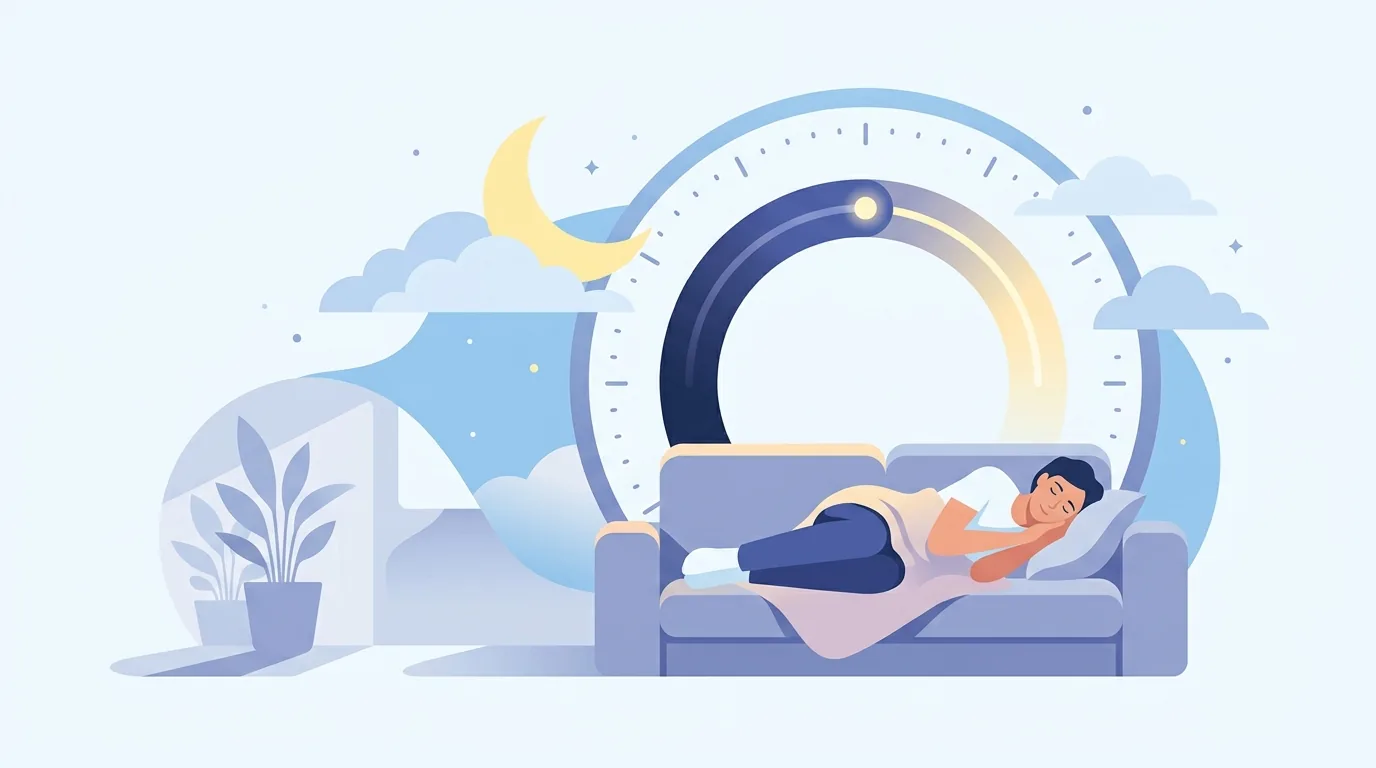
A 90-minute nap is worth taking when you have the time and a real reason: a night shift ahead, a planned late night, or a sleep debt you cannot pay off any other way. The logic is that about 90 minutes is roughly the length of one sleep cycle, so the alarm lands near the lightest part of your sleep instead of in the middle of the deepest part. The cost is that it takes 90 minutes plus the time to fall asleep, it can push tonight's bedtime later, and for an ordinary tired afternoon a 20-minute nap is usually the better trade. The detail most people miss is the alarm: it has to count the minutes you spend getting to sleep, or your "90 minutes" is really 75.
This is about how to run the nap, not a diagnosis. If you need a long nap every day to function, or you are drowsy while driving, that is a question for a doctor, and no timer settles it.
What does a 90-minute nap do that a short one doesn't?
Sleep is not a flat state. Over a nap you move from light sleep into deeper sleep, and the deeper you go, the harder and more unpleasant waking becomes. A short nap works by ending early, before you get that deep. A 90-minute nap works by going all the way down and coming back up.
The CDC's NIOSH training module for nurses on long work hours puts it plainly: both short and long naps can increase alertness and be useful. It says sleep gets deeper over about an hour, and that waking at roughly 20 minutes, before the deeper sleep, or at about 90 minutes, which is predicted to be the end of a sleep cycle, should leave you with less grogginess. It adds that any grogginess you do get should fade within 15 to 30 minutes.
Two things to hold onto from that. First, "predicted" is the honest word. The 90-minute cycle is an average, and your own cycles can run longer or shorter, which is why a calculator's answer is a starting point and not a guarantee. Second, the same source notes that if you are very sleep deprived you may drop into deep sleep faster, and the grogginess can last longer. The people who need a long nap most are the ones for whom the timing is least predictable.
If you want the background on why waking from deep sleep feels so bad, we cover it in why you wake up groggy. And if you are deciding between lengths, the short end of the argument is in the 20-minute nap guide. This post is its honest counterpart.
How do the nap lengths compare?
Here are the five lengths people actually choose, side by side. The "wake from" column is the general pattern described in the CDC module above; the rest is practical reasoning you can check against your own afternoon.
| Nap length | What you tend to wake from | Grogginess risk | Effect on tonight's bedtime | Suits |
|---|---|---|---|---|
| 10 minutes | Light sleep, if you fall asleep at all | Low | Little to none | A quick reset when you have almost no time |
| 20 minutes | Light sleep, before deeper sleep | Low | Little to none | A normal afternoon dip |
| 30 minutes | The edge of deeper sleep | Moderate, and easy to overshoot into more | Small | Only if 20 keeps running long |
| 60 minutes | Deep sleep | Highest | Can be noticeable | Rarely the right target |
| 90 minutes | Near the end of a cycle, lighter sleep | Lower than 60, higher than 20 if you overshoot | Can push bedtime later | Night shift, planned late night, real sleep debt |
Read the table as a decision aid, not a ranking. The 90-minute row is not "best." It is the right tool for a specific job. Everything above it is cheaper in time, and the 60-minute row is a warning, which is the next section.
When is a full-cycle nap worth the time?
Three situations make the extra hour and a half pay for itself.
Before a night shift. If you are about to be awake through your body's low point, sleeping beforehand matters. A study of a simulated night shift published in Scientific Reports tested a 120-minute nap against a split of a 90-minute nap plus a 30-minute nap, with a no-nap group for comparison. It was a small study, 41 women in total across the three groups, so treat it as a pointer and not a rule. Its findings were mixed in an instructive way. The shorter a person's sleep latency, meaning the faster they fell asleep, the worse their alertness was right after the 90-minute nap. Longer total sleep time meant more fatigue and drowsiness on waking. And the split-nap group had less fatigue late in the shift than the groups that took one nap or none. If you work nights, our night shift sleep schedule builds the whole day around this.
Before a planned late night. A wedding, a flight that lands at 2 AM, a deadline. Sleeping ahead of time is the one case where a long nap is a plan and not a slip.
After a real sleep debt. If you slept very little last night, a short nap barely scratches it. A full cycle gives you actual sleep, though it will not erase a week of short nights, and the CDC page's caution about faster descent into deep sleep applies to you.
If none of those describe your day, you are probably tired in the ordinary way, and 20 minutes will serve you better. A nap that eats an hour and a half and then makes bedtime harder is a poor trade for a mild afternoon slump.
Why is 60 minutes often the worst length?
Because it sits in the middle of the deepest part of the cycle.
The CDC module says sleep deepens over about an hour, and that waking at roughly an hour, during deep sleep, can leave you impaired by sleep inertia. That is the groggy, heavy, slightly confused feeling you get when an alarm drags you out of deep sleep. A one-hour nap is long enough to get you there and too short to get you back out, so it is the length most likely to leave you feeling worse than when you lay down.
This is also why people say they "slept an hour and feel terrible." It is not that an hour of sleep is harmful. It is that the alarm fired at the worst possible moment. If you find yourself at the 60-minute mark with no alarm set, the practical choices are to wake up now and accept some grogginess, or to let yourself finish the cycle. Neither is great, which is the argument for deciding the length before you lie down.
How late in the day can you take a long nap?
Earlier is safer, and there is some direct evidence that timing changes the result.
A 2025 study in the journal Sports compared a 90-minute nap at 13:00 and at 15:00 in 14 trained young male athletes, with no-nap conditions as the control. The authors concluded that the 13:00 nap improved performance and recovery more than the 15:00 nap or no nap. It is a small study of one group, and it measured sprint performance and mental tests, not nighttime sleep, so it does not tell you what a 3 PM nap does to your bedtime. What it does show is that "when" is not a detail. The same 90 minutes gave a different result an hour and a half later in the afternoon.
For your own bedtime, a sensible rule is to finish a long nap with several hours still between you and the time you want to sleep. A nap that ends at 6 PM and a bedtime of 10:30 PM is asking for trouble. A nap that ends at 2:30 PM is not. Because everyone's body clock differs, treat any specific cutoff as a starting point and watch what happens that night.
Should the alarm include falling asleep?
Yes, and this is the mechanic that decides whether the whole exercise works.
Nobody falls asleep the instant the timer starts. If you set a 90-minute countdown and take 15 minutes to drift off, you get 75 minutes of sleep, which lands you in the deep-sleep zone from the last section, exactly where you did not want to be. The fix is arithmetic:
- Time to fall asleep (be honest, for a daytime nap it is often 10 to 20 minutes)
- Plus 90 minutes of actual sleep
- Equals the alarm you set
For most people that works out to 1 hour 45 minutes: 90 minutes asleep plus about 15 to get there. If you usually drop off in five minutes, 1 hour 35 is closer. If you lie awake for 25, make it 1 hour 55.
There is a catch the research above points at. In the night-shift study, people who fell asleep fastest were groggier right after a 90-minute nap. So being quick to fall asleep is not a free win. If you are very tired and conk out in two minutes, you may be reaching deeper sleep sooner, and your 90 minutes could end earlier in the cycle than you expect. The honest summary is that the 90-minute number gets you near the right zone, not onto the exact minute.
Two practical details. Put the alarm somewhere you have to sit up to reach, and make it a sound you can actually hear, because sleeping through a nap alarm turns 90 minutes into three hours. Our online alarm clock runs full screen in a browser tab, so keep the device plugged in and awake. And if you want to check the arithmetic on a full night rather than a nap, the sleep calculator uses the same cycle logic.
How does a long nap change tonight's bedtime?
It takes some of the sleep pressure you built up during the day, which can make it harder to fall asleep at your usual time.
The CDC module's advice for daytime workers is a brief nap under 20 minutes, which it says boosts alertness for a couple of hours without disrupting nighttime sleep. That recommendation tells you what the longer nap trades away: it is the short one that is safest for tonight. A 90-minute nap is real sleep, and real sleep early in the afternoon reduces how tired you will feel at 10 PM.
What to do about it depends on why you napped:
- If you napped to cover a late night or a night shift, the bedtime shift is the point. You are sleeping at a different time on purpose, so plan the rest of the day around it.
- If you napped because you were wiped out, expect to be a little less sleepy at your normal bedtime, and do not fight it by going to bed an hour early. Keep your wake-up time the same tomorrow so the shift does not spread across the week.
- If you notice you cannot sleep at night on the days you nap, move the nap earlier, shorten it, or skip it. If it keeps happening, mention it to a doctor, since needing a nap and then not sleeping at night is a pattern worth a professional look.
Keep one thing in mind: a nap is a patch. If you are napping for 90 minutes every day because nights are short, the better fix is the night, not the nap.
Is a 90-minute nap too long?
Not by itself. A 90-minute nap is the length where the CDC module expects the least grogginess among the longer options. It becomes "too long" when it is the wrong tool: you did not need it, it costs you an hour and a half you did not have, or it wrecks your sleep that night. If you got a good night and you are only mildly tired, 20 minutes is the better fit, and the 20-minute nap guide explains how to run that one.
The short version
- Use 90 minutes for a night shift, a planned late night, or a real sleep debt.
- Use 20 minutes for an ordinary afternoon dip.
- Avoid aiming for 60 minutes. It is the likeliest length to leave you groggy.
- Nap earlier in the day, and finish with hours to spare before bed.
- Set the alarm for 1 hour 45 minutes, not 90 minutes, to account for falling asleep.
- Expect tonight's bedtime to shift and plan for it.
FAQ
Is a 90-minute nap too long?
No, not in itself. It lasts about one sleep cycle, and the CDC module says waking at about 90 minutes, near the predicted end of a cycle, should leave you with less grogginess than waking at about an hour. It is too long only when you did not need it, or when it makes tonight's sleep harder.
Is a 90-minute nap better than a 20-minute nap?
It depends on what you need. For an ordinary afternoon dip, 20 minutes is cheaper in time and less likely to disturb the night. For a night shift, a planned late night, or a real sleep debt, 90 minutes gives you more actual sleep. Neither is better in general.
Will a 90-minute nap ruin my sleep tonight?
It might make it harder to fall asleep at your usual time, because you used up some sleep pressure during the day. Napping earlier helps, and a short nap is safer for the night. If long naps keep costing you sleep, shorten them or move them earlier, and mention the pattern to a doctor if it persists.
Why do I feel worse after a one-hour nap?
An hour is roughly when sleep is at its deepest, and the CDC module notes that waking from deep sleep can leave you impaired by sleep inertia. The alarm went off at a bad moment, not because an hour of sleep is harmful. Aim for about 20 minutes or a full 90 minutes instead.
Set it up now
Start a 90-minute nap with the arithmetic done for you: set an alarm for 1 hour 45 minutes on the online alarm clock. That is 90 minutes asleep plus 15 to get there, so you wake near the end of a cycle and not in the middle of one.