
Military Time Chart: Convert 24-Hour Time Fast
By Mark Fulton · 2026-08-24 · 12 min read
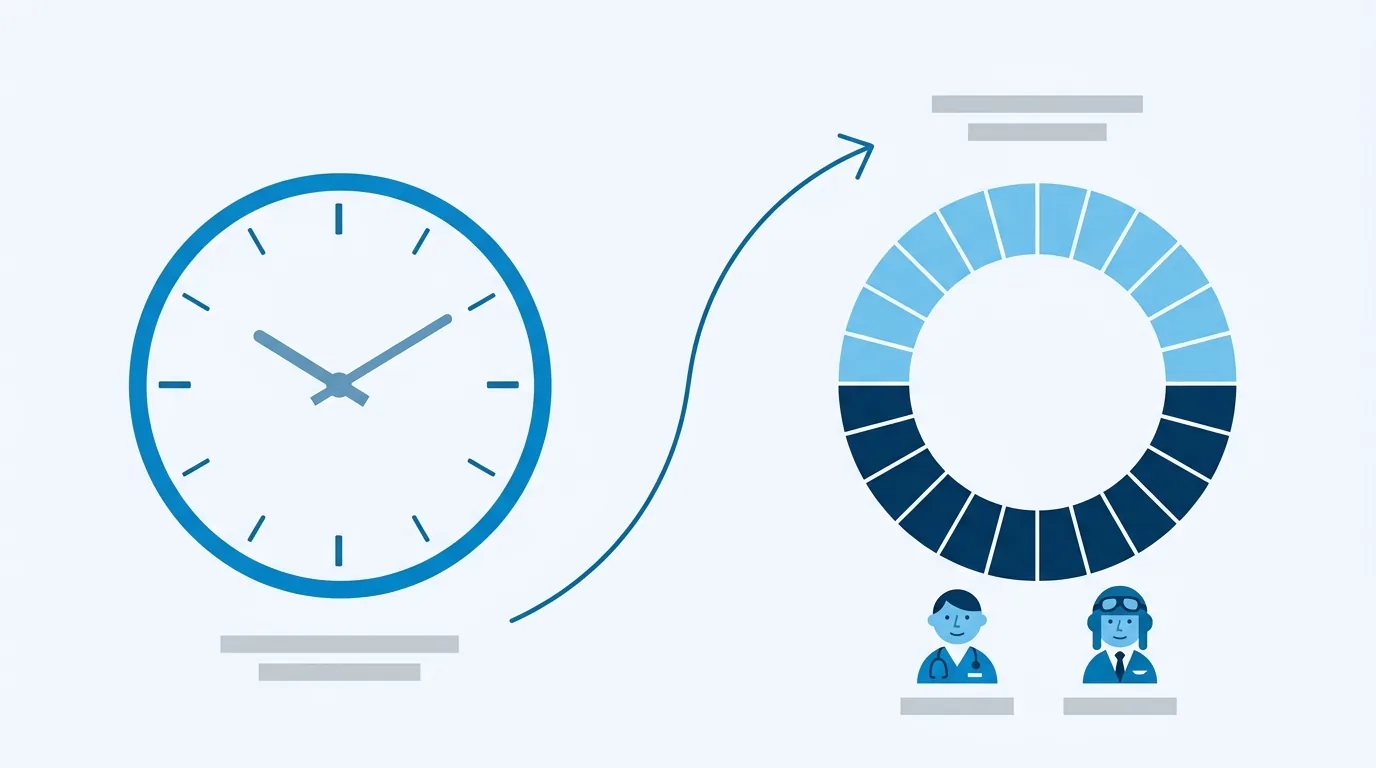
Military time is the 24-hour clock written as four digits with no colon and no AM or PM. Before noon the digits are the ones you already know with a leading zero, so 9:00 AM is 0900. From 1:00 PM onward you add 12 to the hour, so 6:00 PM is 1800 and 9:00 PM is 2100. Going the other way, subtract 12 from anything above 1200: 1430 minus 12 hours is 2:30 PM. The minutes never change in either direction. That is the whole rule, and the chart below has every hour laid out so you do not have to do the arithmetic at all.
The chart is the easy half. The half that actually causes errors on a chart, a log or a flight plan is everything around it: why midnight has two spellings, how the minutes are said out loud, and the handful of predictable ways people get it wrong. That is what the rest of this page covers.
How do you read military time?
Read the four digits as two pairs. The first pair is the hour, from 00 to 23. The second pair is the minutes, from 00 to 59. There is no colon, no AM, no PM, and no ambiguity, because every one of the 1,440 minutes in a day has exactly one four-digit spelling.
Two habits make it readable at a glance rather than calculable:
The leading zero is not decoration. 0730 is half past seven in the morning. Written as 730 it is a three-digit number that a person scanning a column will read as seven-thirty of some unspecified kind, and that a spreadsheet will sort in the wrong place. Four digits, always.
Anything starting with 1, 2 or 0 tells you the half of the day before you finish reading. A 0 or a 1 in front of a digit under 2 is morning. Anything from 13 up is afternoon or evening. You stop converting after a week or so and just read it.
Here is the full chart. The spoken column is how each time is normally said, and the last column is the specific thing that goes wrong at that hour.
| Standard time | 24-hour (military) | Said out loud | Watch out for |
|---|---|---|---|
| 12:00 AM (midnight) | 0000 | "zero zero zero zero" or "zero hundred" | The one hour with two spellings. See 2400 below. |
| 1:00 AM | 0100 | "zero one hundred" | Not 1300. Morning hours are never shifted. |
| 2:00 AM | 0200 | "zero two hundred" | |
| 3:00 AM | 0300 | "zero three hundred" | |
| 4:00 AM | 0400 | "zero four hundred" | |
| 5:00 AM | 0500 | "zero five hundred" | |
| 6:00 AM | 0600 | "zero six hundred" | |
| 7:00 AM | 0700 | "zero seven hundred" | Often written 700 by mistake. Keep the zero. |
| 8:00 AM | 0800 | "zero eight hundred" | |
| 9:00 AM | 0900 | "zero nine hundred" | |
| 10:00 AM | 1000 | "ten hundred" | |
| 11:00 AM | 1100 | "eleven hundred" | |
| 12:00 PM (noon) | 1200 | "twelve hundred" | Noon is 1200, not 0000. Do not add 12 to it. |
| 1:00 PM | 1300 | "thirteen hundred" | |
| 2:00 PM | 1400 | "fourteen hundred" | |
| 3:00 PM | 1500 | "fifteen hundred" | |
| 4:00 PM | 1600 | "sixteen hundred" | |
| 5:00 PM | 1700 | "seventeen hundred" | |
| 6:00 PM | 1800 | "eighteen hundred" | The most looked-up conversion of the lot. |
| 7:00 PM | 1900 | "nineteen hundred" | |
| 8:00 PM | 2000 | "twenty hundred" | |
| 9:00 PM | 2100 | "twenty-one hundred" | |
| 10:00 PM | 2200 | "twenty-two hundred" | |
| 11:00 PM | 2300 | "twenty-three hundred" | |
| 11:59 PM | 2359 | "twenty-three fifty-nine" | The last minute of the day. The next minute is 0000 of the next day. |
| 12:00 AM (end of day) | 2400 | "twenty-four hundred" | Same instant as 0000, different day. |
| Minutes work the same at every hour | |||
| 6:15 PM | 1815 | "eighteen fifteen" | |
| 6:30 PM | 1830 | "eighteen thirty" | Not 18.5. The last two digits are minutes, never a decimal. |
| 6:45 PM | 1845 | "eighteen forty-five" | |
| 12:05 AM | 0005 | "zero zero zero five" | Five past midnight, not five past noon. |
| 12:45 PM | 1245 | "twelve forty-five" | Quarter to one in the afternoon. |
What is 1800 in standard time?
1800 is 6:00 PM. Take the hour pair, 18, subtract 12, and you get 6, which lands in the PM half because you had to subtract at all. The minutes are 00, so it is exactly six in the evening. Spoken, it is "eighteen hundred", and depending on where you are it may or may not be followed by the word "hours".
The same subtraction handles every evening time you are likely to meet:
- 1700 is 5:00 PM
- 1800 is 6:00 PM
- 1830 is 6:30 PM
- 1900 is 7:00 PM
- 2000 is 8:00 PM
- 2130 is 9:30 PM
The reason 1800 in particular gets looked up more than its neighbours is that it is the hour most schedules land on. Shift changes, dinner, muster, appointment reminders and event start times cluster there, so it is the number people meet cold in a message and need to decode in a second.
Is midnight 0000 or 2400?
Both, and the difference is which day you mean.
Midnight sits on the boundary between two dates, which makes it the one moment on the clock that a single label cannot pin down. The US National Institute of Standards and Technology is direct about this. It calls 12 a.m. and 12 p.m. ambiguous and recommends against them, and where a 24-hour clock is used it points to 0000 for midnight at the beginning of a given date and 2400 for midnight at the end of that date. NIST also gives the plain-language workaround for contracts and policies where the exact instant matters legally: write 11:59 p.m. or 12:01 a.m. and the boundary problem disappears.
That gives you a rule you can apply without thinking about it:
- 0000 opens a day. A shift starting at midnight going into Tuesday starts at 0000 Tuesday.
- 2400 closes a day. A permit valid until midnight at the end of Monday expires at 2400 Monday, which is the same instant as 0000 Tuesday.
- Clocks that tick, including ours, only ever show 0000, because a running clock is always at the start of the day it is currently in. 2400 is a notation for a boundary in a written schedule, not a time a clock displays.
The trap is a deadline written as "2400 Monday" and read as "the start of Monday". That is a full day of error, and it is the single most expensive mistake on this page. When you write a midnight deadline for someone else, the kindest thing you can do is write the date beside it or use 2359 and remove the argument entirely.
How do you say minutes out loud?
Written and spoken forms are not the same thing, which surprises people who learned the chart and then heard it used.
On the hour, you say "hundred". 1500 is "fifteen hundred". 0600 is "zero six hundred", sometimes "oh six hundred" in ordinary speech. The word "hundred" here is not arithmetic, it is just what a pair of zeroes in the minutes slot is called.
Off the hour, you say the minutes as a number and drop "hundred" completely. 1845 is "eighteen forty-five". 0730 is "zero seven thirty". Saying "eighteen hundred forty-five" is the giveaway that someone learned this from a chart rather than from use.
Single-digit minutes get their zero spoken. 1805 is "eighteen zero five". 0009 is "zero zero zero nine".
Whether "hours" follows depends on where you are. In common US military usage the word is often appended, particularly on the hour, giving "eighteen hundred hours". Other services and other countries drop it as a matter of course, and civilian 24-hour speakers almost never use it. Nobody will misunderstand you either way, so match whoever you are talking to rather than trying to be correct in the abstract.
Who uses the 24-hour clock and why?
Most of the world uses it for anything written down, and the places that adopted it hardest are the ones where a misread time causes something worse than a missed lunch.
Healthcare. Nursing documentation standards teach 24-hour time as the default for medication administration. The Nursing Skills open textbook from Chippewa Valley Technical College, hosted on the NIH's NCBI Bookshelf, makes the reasoning explicit: recording doses as 0700 and 1900 rather than 7 AM and 7 PM removes AM/PM confusion and prevents the duplicate dose that happens when two entries of "7:00" sit in the same record.
Aviation. The FAA's Aeronautical Information Manual describes the 24-hour clock system used on the radio, with the hour given by the first two figures and the minutes by the last two, and the word "Zulu" used to denote Coordinated Universal Time. It also allows time to be stated in minutes only, as two figures, when no misunderstanding is likely, which is why you will hear a controller give a time as a bare two-digit number. Flight operations run on UTC rather than local time precisely so that a crossing of time zones or a daylight saving switch never renames the moment.
The military, which is where the American nickname comes from, along with rail and transit timetables, emergency services, broadcast scheduling and most of the software you use, all of which stores time in a 24-hour form whatever it shows you on screen.
The common thread is not tradition. It is that the 12-hour clock encodes the same number twice a day and relies on a two-letter suffix that is easy to omit, easy to mistype and impossible to recover once it is lost. If you want the layer underneath all of this, where the offset itself changes and the same wall-clock hour repeats or vanishes twice a year, we went through that in how UTC, time zones and DST actually work. The 24-hour clock fixes the AM/PM problem. It does not fix the time zone problem, and confusing the two is its own source of errors.
What are the common conversion mistakes?
Four errors account for nearly all of the real ones.
1. Adding 12 to a morning hour. The add-12 rule only applies from 1:00 PM. Applying it to 8:00 AM gives 2000, which is eight in the evening and twelve hours from where you meant. If the original time was AM, the digits do not move.
2. Doing something to 12. Both twelves are exceptions to the pattern, in opposite directions. Noon is 1200: it is already there, do not add anything. The midnight hour is the 00 hour, so 12:30 AM is 0030, not 1230. Half past midnight written as 1230 is half past noon, and that mistake in a medication record or an incident log is a twelve-hour error in a document people trust.
3. Reading the minutes as a decimal. 1830 is 6:30 PM, not 18.3 or 18.5 of anything. This one bites hardest on timesheets, where a payroll field may genuinely want decimal hours while the clock beside it shows 24-hour time. A shift ending at 1815 is 8.25 hours after 1000, not 8.15. Decide which of the two formats a column holds and never mix them.
4. Dropping the leading zero, or floating 2400. Three-digit times break sorting and invite a PM reading. And 2400 used anywhere except the explicit end of a stated date will eventually be read as the start of one. Use four digits every time, and prefer 2359 or 0000 with the date attached when a deadline actually matters.
A useful habit for any of these: when you convert a time you plan to act on, say the result out loud in the other format. "Eighteen thirty, six thirty in the evening." Errors of twelve hours are obvious to your ear in a way they are not to your eye scanning a column.
Frequently asked questions
What time is 1800 hours?
6:00 PM. Subtract 12 from the hour pair: 18 minus 12 is 6, and because you had to subtract, it is the PM half of the day. Spoken, "eighteen hundred".
Do you say "hundred hours" for every time?
No. "Hundred" is only used when the minutes are 00. 1800 is "eighteen hundred", but 1845 is "eighteen forty-five" with no "hundred" in it at all. The trailing word "hours" is optional and varies by service and country, so it is a style choice rather than a rule.
Is military time the same as the 24-hour clock?
The underlying system is identical. The difference is written style. Military notation drops the colon and uses four digits, as in 0930. Civilian 24-hour notation, the form used across most of the world and in the international standard for writing dates and times, keeps the colon and writes 09:30. Same instant, same hours, different punctuation.
Why do hospitals use 24-hour time?
To make a recorded time mean one thing. A medication entry of "7:00" has two readings twelve hours apart, and an unnoticed duplicate is a second dose. Written as 0700 and 1900 it has one reading, which is why nursing documentation standards teach 24-hour time as the default for anything administered on a schedule.
Keep a 24-hour clock in front of you while you learn it
The fastest way to stop converting is to spend a few days reading the format instead of translating it. Open our military time clock on a second screen or a spare phone and leave it there. It shows the current time locked to 24-hour format, updating live, with optional seconds and date, a full-screen mode, and a control that hides the styling chrome so the digits are all that is left. Glance at it while you work and 1600 stops being arithmetic and starts being four in the afternoon.
If you would rather have the choice of both formats on the same face, the digital clock has a 12 and 24-hour switch, and the world clock shows the cities you work with side by side, which is where 24-hour time earns its keep fastest. All three are free in the browser with no signup and no account. Pro adds extra scenes and typefaces if you want a nicer face to leave up, and it never puts a clock, a timer or an alarm behind a paywall.