
Boiled Egg Timing Chart: 6 to 13 Minutes
By Mark Fulton · 2026-08-31 · 12 min read
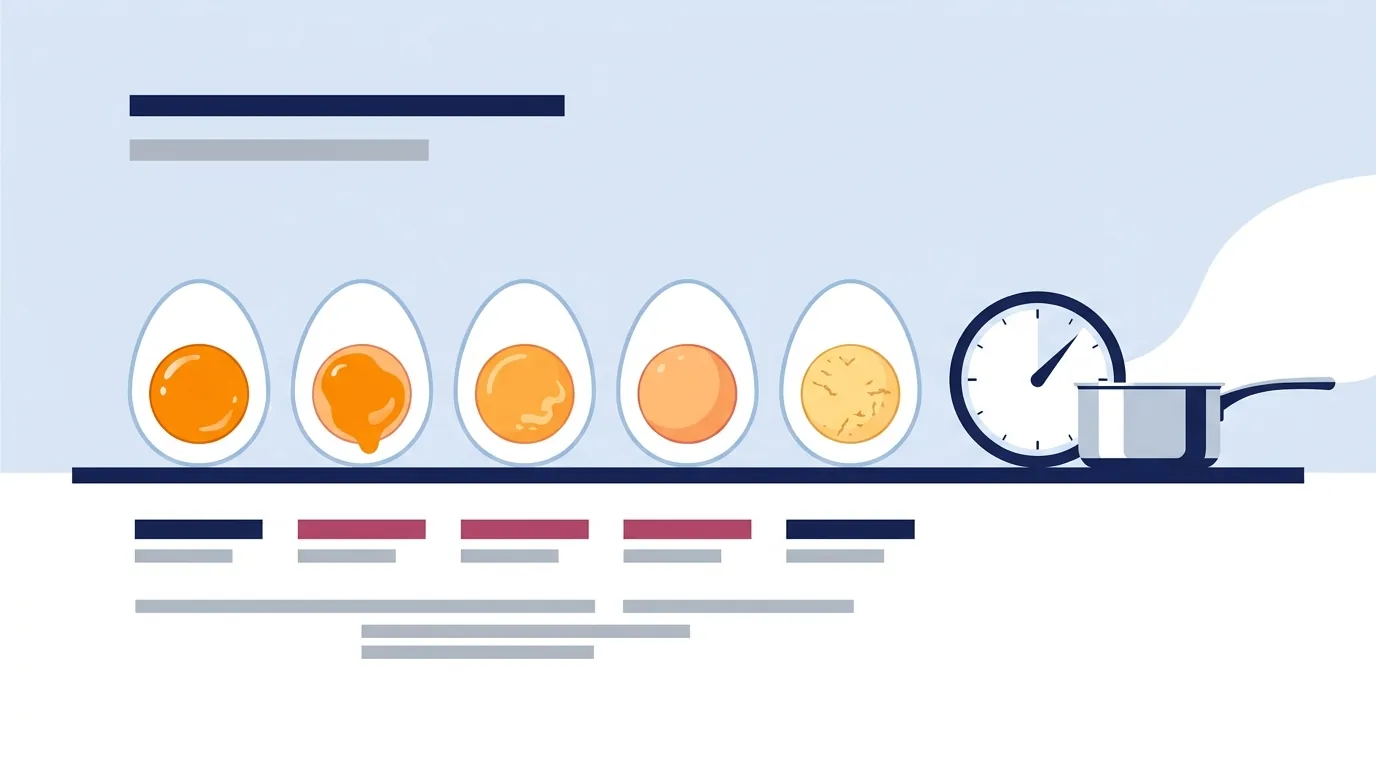
Lower a large, fridge-cold egg into water that is already at a rolling boil and the whole range lives between six and thirteen minutes. Six gives a liquid yolk with a set white. Seven gives the jammy, spoonable middle. Nine gives a yolk that is set but still tender. Eleven is firm and bright. Thirteen is fully hard, pale, and slices clean for sandwiches and salads. Every minute in that range is a different egg, which is why "boil an egg" has never been one instruction.
The chart below is the whole answer, laid out against the two variables that make every published set of minutes disagree with every other: whether the egg went into boiling water or came up from cold, and whether it came out of the fridge or off the counter. Pick your row, set the number, walk away.
How long do you boil an egg for each doneness?
These are minutes for a large egg, straight from the fridge, in a pan with enough water to cover it by about an inch. The boiling-start column is timed from the moment the egg goes into water that is already boiling hard. The cold-start column is timed from the moment a pan of cold water and eggs first reaches a rolling boil, after which you drop it to a gentle simmer.
| Doneness | What the yolk looks like | Boiling start | Cold start (from the boil) | Set the timer |
|---|---|---|---|---|
| Runny | Liquid all the way through, pours out and coats a spoon or a soldier of toast | 6 min | about 4 min | Egg timer |
| Jammy | Thick and glossy, holds its shape on a knife, still visibly wet in the middle | 7 min | about 5 min | Egg timer |
| Soft-set | Fully opaque and tender, no liquid left, no chalkiness either | 9 min | about 7 min | Egg timer |
| Firm | Solid and deep yellow, cuts without smearing, still moist | 11 min | about 9 to 10 min | Egg timer |
| Fully hard | Pale, crumbly, dry enough to grate or mash for egg salad | 13 min | about 12 min | Egg timer |
Two honest notes about that table before you use it.
The boiling-start column is the one I would trust in someone else's kitchen. It has exactly one moment of ambiguity, the moment the egg hits the water, and that moment is unmistakable. Published charts cluster tightly around these numbers and disagree by roughly a minute, mostly at the firm end.
The cold-start column is the least transferable set of numbers on this page, and anyone presenting it as precise is overselling it. A cold start bakes in a variable that nobody can standardise for you: how long your pan, your burner and your particular number of eggs take to climb from tap-cold to boiling. Real cooking happens during that climb, above roughly 60°C, well before the water is visibly rolling. A wide pan with two eggs and a heavy pan with eight are running different recipes. Treat those figures as a starting guess and adjust once, on your own stove.
Below six minutes you leave the chart and enter dippy-egg territory, where the white itself is only just set and the egg is really a vehicle for toast. Three to four minutes does that. It is a genuinely different food, not a shorter version of a soft-boiled egg, which is why it sits outside a chart built around yolk texture.
Does a cold start change the timing?
Yes, and by more than most people expect, because a cold start is not a delayed version of a boiling start. It is a slow ramp through the exact temperature band where egg proteins set.
Egg white firms up well below boiling. The yolk follows a little higher. In a boiling start, the egg crosses that band in a rush and then sits in fully boiling water for the rest of the time, so the minutes on the clock are close to the minutes of actual cooking. In a cold start, the egg spends several minutes drifting up through that band before the water ever boils. By the time you see the first proper rolling boil, the white is already partly set and the yolk has begun to firm at the edges. That is why the cold-start column runs about two minutes short of the boiling-start column at the runny end.
The gap narrows as you go down the chart. Once you are aiming for a fully hard yolk, the ramp is a smaller fraction of the total, and the two methods converge to within a minute of each other.
There is a third method worth knowing, because it appears in a lot of published advice and it is not really a boil at all. You cover the eggs with cold water, bring the pan to a boil, then kill the heat, put the lid on, and let the eggs stand in the cooling water. The University of Illinois food science explainer on green yolks describes this approach and gives 12 minutes of standing for medium eggs and 18 for extra-large, specifically as a way to avoid the aggressive heat that discolours the yolk. If you have ever wondered why one chart says 10 minutes and another says 18 for what sounds like the same egg, this is usually the reason. They are not timing the same process.
Do fridge-cold eggs need longer?
Yes, by roughly 30 seconds to a minute, and the effect is largest at the runny end where 30 seconds is a visible difference in the yolk.
An egg out of the fridge starts around 4°C. An egg that has sat on the counter for half an hour starts closer to 20°C. That is 16 degrees of head start, and in a six-minute egg it matters. It matters far less in a thirteen-minute egg, where the yolk has long since reached its final state and extra time only makes it drier.
The practical move is not to warm your eggs. It is to pick one starting temperature and always use it, because consistency is what makes a chart useful. Fridge-cold is the easier standard to hold, since it needs no planning and no guessing about how long the eggs have been out. Every number in the table above assumes it.
Cold eggs going into boiling water do crack more readily. Lowering them in on a spoon rather than dropping them, and using a pan wide enough that they are not knocking against each other, prevents most of it. A cracked egg is not a ruined one, just a scruffier one.
Why does everyone's egg time disagree?
Because at least five variables sit underneath a single number, and most charts only tell you about one or two of them.
Where the timer starts. This is the big one, and it is usually invisible. Some charts start the clock when the eggs go into boiling water. Some start it when a cold pan first boils. Some start it when the burner goes on. Those three conventions can be five minutes apart for an identical egg and an identical result, and a chart that does not say which one it means is not really a chart.
Egg size. Timings are almost always written for large eggs. Medium eggs finish sooner and extra-large need longer, which is why the standing method above quotes 12 minutes for medium and 18 for extra-large rather than one figure.
Altitude. Water boils cooler as you go up, so the heat driving the cooking is lower even though the water looks identically furious. New Mexico State University's high-altitude cooking guide puts the boiling point at 212°F at sea level, about 208°F at 2,000 feet, about 202°F at 5,000 feet and about 198°F at 7,500 feet, roughly a 1°F drop per 500 feet of elevation. The same guide notes that a soft-boiled egg that takes 3 minutes at sea level may take 5 to 6 minutes at high elevation, and that hard cooking at 5,000 feet takes about 25 minutes by their standing method. If you live above about 5,000 feet, sea-level charts are not going to work for you unadjusted.
Pan and quantity. Eight eggs dropped into a small pan pull the temperature down and take longer to recover than two eggs in a wide one. During those seconds the water is not boiling, and the clock does not know that.
What the writer means by the word. "Soft-boiled" means a liquid yolk to one cook and a tender set yolk to another. That single word accounts for a surprising share of the disagreement. It is why the chart above describes the yolk rather than relying on the label to carry the meaning.
None of this makes the numbers useless. It just means the first time you use a chart is a calibration run, not a guarantee. Note what you got, adjust by 30 seconds in the direction you want, and the second attempt is yours for good.
When should the ice bath go in?
The moment the timer goes off, without a pause to find a bowl.
An egg does not stop cooking when it leaves the water. It is a hot dense object with a hot centre, and it keeps carrying that heat inward for a couple of minutes. A six-minute egg left to cool on the counter is a seven-minute egg by the time you crack it. If you are timing to the minute, carryover cooking is the thing that quietly undoes the timing.
Cold water arrests it. Extension guidance on the discoloured ring is direct about the cooling step: the University of Nebraska extension page on the green ring advises running cold water over just-cooked eggs or putting them into a bowl of ice water until they have completely cooled, then refrigerating them in the shell, where it notes hard-cooked eggs keep for up to a week.
So set the bowl up before you start the timer. Cold water, a handful of ice, sitting next to the pan. When the chime goes, the eggs go in. For soft and jammy eggs, thirty to sixty seconds in the ice bath is enough to stop the cooking and still leave them warm to eat. For anything you intend to peel cold, leave them until they are cold all the way through, which takes several minutes and is much easier to judge by feel than by clock.
Ice water also helps with peeling. The rapid contraction encourages the membrane to pull away from the white. It is not magic, and a very fresh egg will still fight you, but it is the single cheapest improvement available.
How do you time several batches without losing track?
Two eggs is a timer. Six eggs at three donenesses for four people is a small logistics problem, and the failure mode is always the same: you remember roughly when you started and you are wrong by ninety seconds.
The cleanest approach is one pan, one clock, staggered removal. Put every egg in at once, start a single timer at the longest doneness on your list, and pull each egg out as its own moment passes. If you want jammy at 7 and firm at 11, you start one 11-minute count and lift two eggs out when it reads 4:00 remaining. One clock, one start moment, no arithmetic under pressure. A countdown timer that shows the remaining time in large digits makes this genuinely easy, because you are reading a number across the kitchen rather than doing subtraction. For a straight batch of hard-boiled eggs with nothing coming out early, a plain 10 minute timer is the whole setup.
The other approach, for when the eggs go in at different times, is a stopwatch counting up with laps, because a count-up never needs resetting between batches and the lap list records what actually happened rather than what you meant to happen.
Either way, keep the tab open and let the chime do the work. Browsers slow down pages you are not looking at, which is why some web timers drift while you are chopping herbs. The timers here anchor to an absolute end time rather than counting ticks, so the count stays right through a background tab, though the chime itself can be delayed by a fraction of a minute in a tab that has been hidden a long while. There is a fuller explanation in why online timers keep the right count in background tabs. For eggs, the practical version is short: leave the timer tab visible if you can, and keep the volume up.
Frequently asked questions
How long is a 6-minute egg really?
Six minutes from the moment a large, fridge-cold egg enters already-boiling water. It gives a fully set white and a yolk that is liquid throughout and still bright orange. If your six-minute eggs keep coming out jammy rather than runny, the likely cause is that you started the clock when the eggs went in but the water had dropped off the boil and taken thirty seconds to recover, or that the eggs were at room temperature. Both push you a minute along the chart.
Should you start eggs in cold or boiling water?
Boiling, if you care about repeatability. A boiling start has one unambiguous moment to time from, so the same number gives the same egg tomorrow. A cold start hides several minutes of real cooking inside a ramp that depends on your pan and your burner, which is exactly the variable a chart cannot carry across kitchens. The cold-start column above exists because plenty of people cook that way and deserve a number, not because it is the better method.
Does egg size change the timing?
Yes. Charts, including this one, are written for large eggs. Medium eggs run about half a minute fast and extra-large about half a minute to a minute slow. Published methods take this seriously enough to quote separate figures for different sizes, as with the 12-minute and 18-minute standing times noted above for medium and extra-large. If you buy one size consistently, calibrate once and stop thinking about it.
Why did my yolk go grey?
It is overcooking, and it is harmless. The University of Nebraska extension explains the greenish-grey ring as a reaction between sulfur from the white and iron from the yolk, which form ferrous sulfide at the surface of the yolk, and describes the result as unattractive but not harmful. The University of Illinois food science explainer makes the same point about safety, noting that the compound is the same form of iron found in iron supplements.
Two things prevent it. Do not go past the time you actually want, since every minute beyond fully hard is only buying discolouration and a drier yolk. And cool the eggs fast in cold or ice water, because a slow cool at the end is still cooking time as far as the reaction is concerned.
One more thing worth saying plainly: a runny yolk is, by design, not fully cooked. Standard food-safety advice is that people who are pregnant, very young, elderly or immunocompromised stick to eggs cooked until both white and yolk are firm, which on this chart means the bottom two rows.
Pick your doneness, then set it running on the egg timer. The presets there are labelled by outcome rather than by bare minutes, and the custom field takes any number from the chart above, so you can dial in the exact egg you argued yourself into wanting. Press start when the water comes back to a rolling boil, not when the eggs go in.